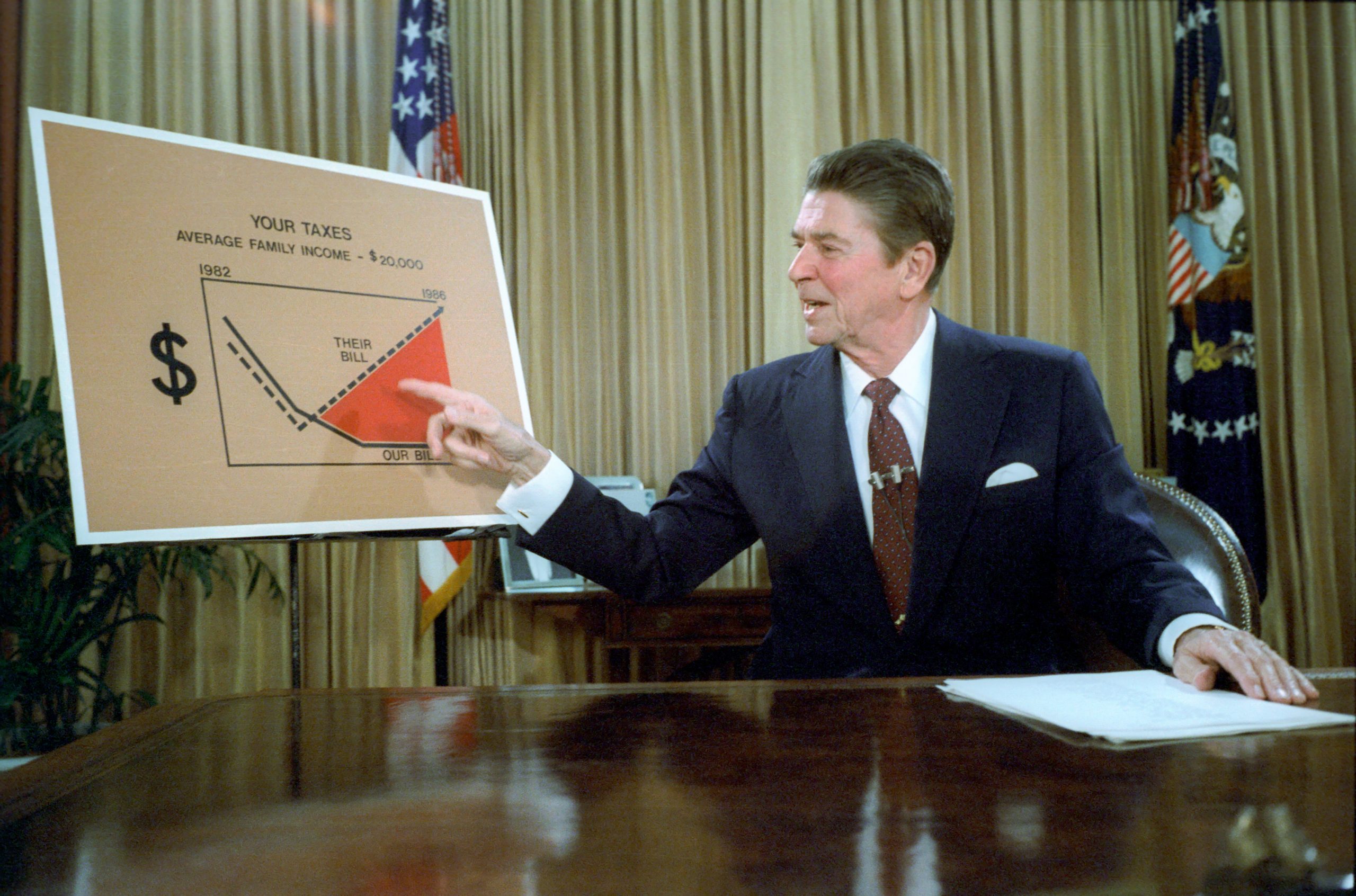
So, when were we great? When were we last the leading nation in a progressive sort of way?

So, when were we great? When were we last the leading nation in a progressive sort of way?
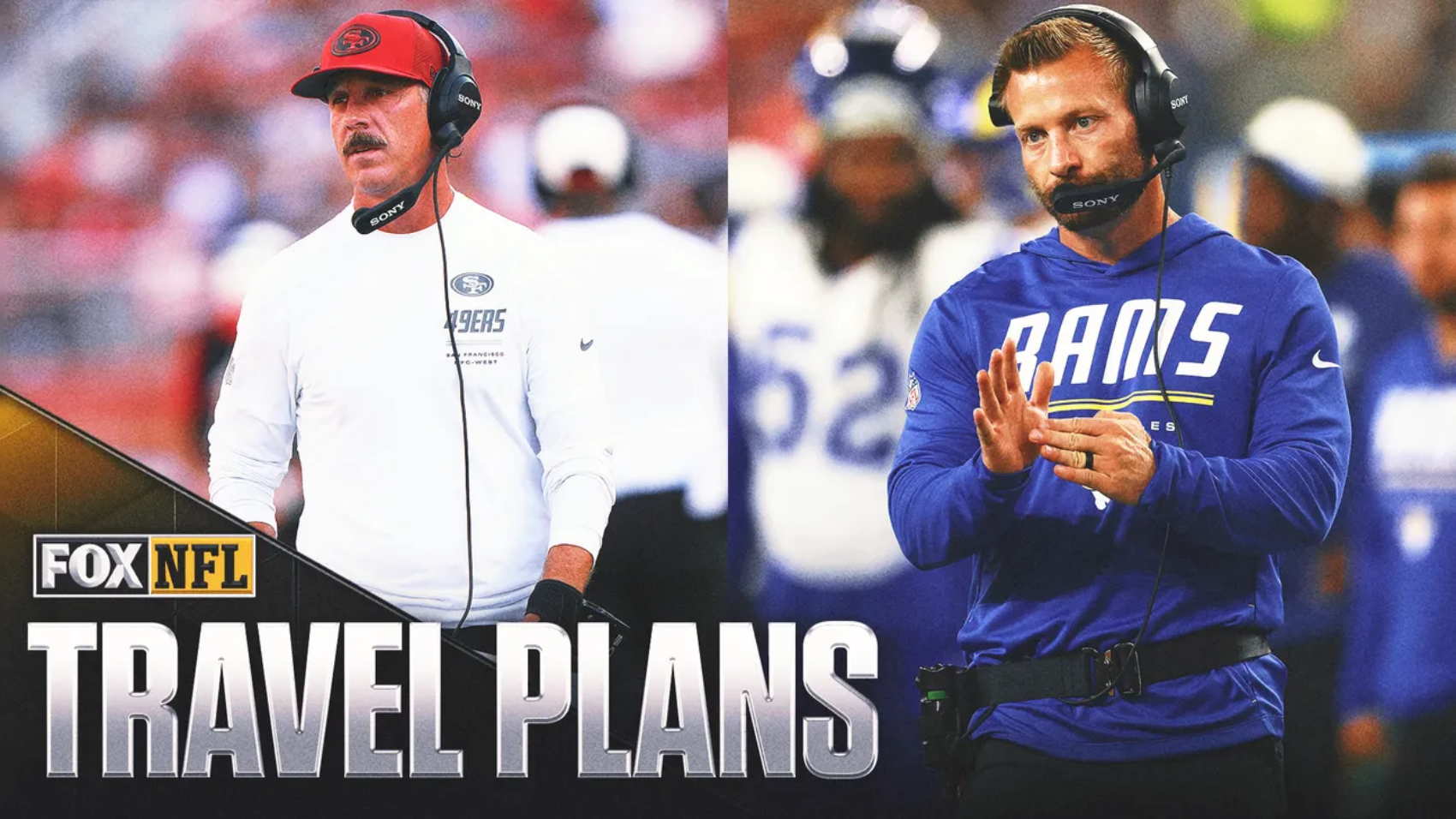
I was trying to gauge how long it takes to get there. It’s a 15 to 20 hour flight from basically both LAX and SFO, and flying from New York or New Jersey tacks on another 5 hours. Flying from the West Coast takes around 17 hours according to my calculation over Sunday breakfast with my dad. He stated that tourists probably stay there a couple weeks or more to make the trip worthwhile. That’s how the San Francisco 49ers are planning for Week 1, because they are there practicing today.
The Rams have a totally different plan. They fly to Melbourne the day before kickoff, get set for the game on Thursday, and then take another flight back home on Friday. Granted, one does feel energized when traveling through time zones, and so they’ll have no real time to get used to any climate issues or adjust to that time zone.
LA is preparing for the game in Los Angeles while the Niners are at the field in Australia practicing there all week. The Rams in general have always had many travel miles every year. Everyone that has to come to LA can deal in one-off’s, while the Rams have to travel to Central USA and also handle our constant travel for games on the East Coast, which can be grueling at times. Now we face travel time that is longer than a half day but in the opposite part of the world.
An Australian game with two different strategies. I must admit that I am a bit weird about it, considering there is no time for error and delay. I am also on the fence whether Aaron Donald will get any play time. I can bet the house that he wants to play and he wants to play sooner than later. I am very curious to see what he’s got this season. Donald is not only traveling with the team, coach Sean McVay did not provide any updates during Sunday’s media hour. I have not even seen him play at all this year. I did not see any practice sessions with him at play. I have not seen him play since that day the team won the Super Bowl. Although, we did get to see a totally drunk while being half clothed Aaron Donald at the parade.
The players will have access to beds I am sure during flights to and from Australia.
On another note, the Rams expect both Puka Nacua and Alaric Jackson to play against the 49ers in Australia despite both of their off-field incidents. Nacua was sued by a woman who alleges that he ‘grabbed her by the pussy’ so to speak while he made an antisemitic remark and again, felt some need to bite her on the shoulder during a New Year’s Eve incident, and Jackson was arrested in June but not charged after a domestic violence incident came and went. The District Attorney has not gone ahead with those charges.
Los Angeles Rams head coach Sean McVay expects both star wide receiver Puka Nacua and left tackle Alaric Jackson to be on the field this week in Melbourne.
McVay confirmed in that Sunday media session that he doesn’t think either player will be suspended for the team’s season opener against the San Francisco 49ers. Jackson will most likely face a 4 to 6 game suspension this year, whereas I do not believe Puka will get any.
“Absolutely,” McVay said Sunday when asked if he thought both players would be available, via ESPN’s Sarah Barshop. “That’s what I’ve heard. I haven’t heard anything different.”
I am not really into rehashing those behaviors of either player. We let it play out naturally, and I have the greatest hope they will not act that way again toward women. Someone did file a lawsuit against Nacua earlier this year over the antisemitic remark and biting allegations described above, which is odd behavior that again, I hope is behind the adult who makes a lot of money every year, to not use racial slurs and to not bite anyone, let alone a woman. The woman’s suit claims gender violence, assault and battery, and negligence. Nacua denied the allegations, though he did enter rehab to help work through it.
Worth noting since this has kept moving, an ex-girlfriend also came forward with separate abuse allegations covering their four year relationship, posted publicly on September 1. Neither the Rams nor the NFL has announced any discipline connected to either situation as of this writing.
Nacua was also involved in several incidents last season, including appearing on a live stream before a game and agreeing to perform an antisemitic touchdown celebration. In his defense, he states that he did not know it was antisemitic. I’ve explained Puka many times. He is a kid. He acts like a kid. He does need to grow up now that he has one of the best jobs ever made in the history of jobs. He entered a so called holistic care facility this past offseason to focus on his personal maturity level and has been practicing and preparing for the 2026 campaign normally with the Rams.
Nacua also had a career-high 1,715 yards and 10 touchdowns last season with a league-high 129 catches.
Jackson was arrested on domestic violence charges in June. He was not charged with the felony, however, and his case was assigned for a pre-filing diversion program as an alternative to misdemeanor criminal prosecution. Therefore, he must learn how to act like an adult, or he faces those charges if he fails to complete it. Jackson is entering his sixth season in the league. The former Iowa star signed a three-year, $57 million extension this year.
Both Jackson’s case and Nacua’s case are under review by the NFL. The league could still hand down punishment and suspend either or both players before Thursday’s game in Australia (8:35 p.m. ET, Netflix). Like I alluded to above, Jackson will get hit because the league has always suspended him for personal incidents off the field before. The Rams know what is up and what to expect, but when it happens could be any minute.
Everyone can watch, listen to, and live stream Rams vs. 49ers in Melbourne, Australia, in Week 1 on Sept. 10, 2026. The game will air on Netflix and also on the Sunset app. Kickoff for Thursday night’s game is scheduled for 5:35 p.m. Pacific time.
The Rams and 49ers last met in Week 10 of the 2025 season, a 42-26 Rams victory in San Francisco. Rams quarterback Matthew Stafford threw for 280 yards and four touchdowns, with wide receivers Davante Adams and Puka Nacua, along with tight ends Colby Parkinson and Davis Allen, on the receiving end of those touchdowns. Running back Kyren Williams had 73 rushing yards and two touchdowns, while Blake Corum added 56 yards on the ground. Defensively, cornerback Emmanuel Forbes Jr. had an interception and led the team with two pass breakups. Inside linebacker Nate Landman had two tackles for loss and 11 total tackles, tied for the team lead with safety Quentin Lake and inside linebacker Omar Speights.
Netflix (also locally on KNBC)
Play-by-play: Noah Eagle
Color analyst: Luke Kuechly
Sideline: MJ Acosta & Tom Pelissero
Stream via NFL+, the Netflix app, or the Sunset app.
ESPN LA 710 AM (also SiriusXM Ch. 192)
Play-by-play: J.B. Long
Color analyst: Maurice Jones-Drew
Sideline: D’Marco Farr
La Primera Radio 1330 AM
Play-by-play: Troy Santiago
Color analyst: Ricardo Lopez
ESPN LA Affiliate Stations
Instagram: @rams · Facebook: /rams · X: @RamsNFL · TikTok: @rams
Make your predictions at therams.com/pickem for a shot at these prizes:
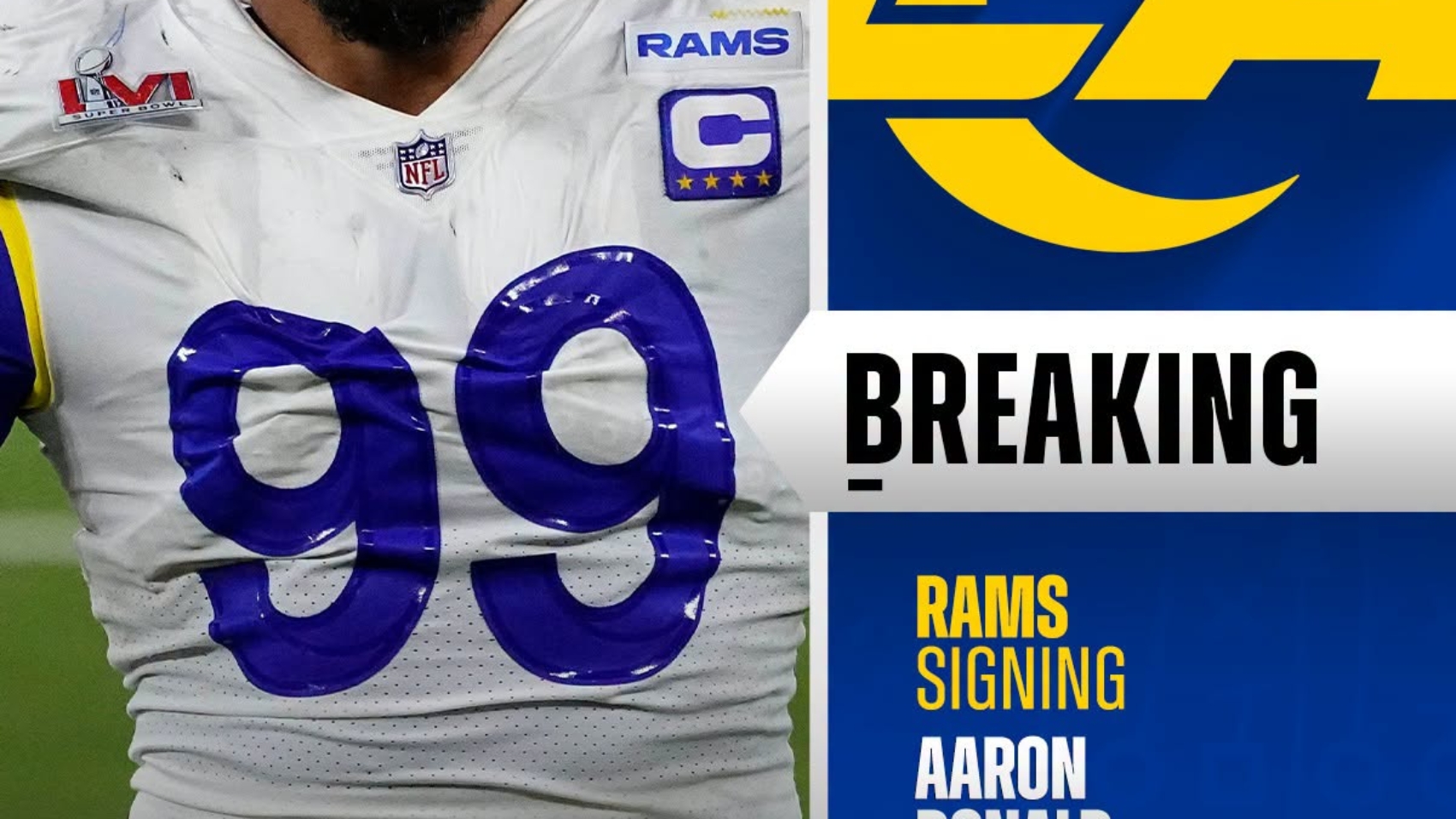
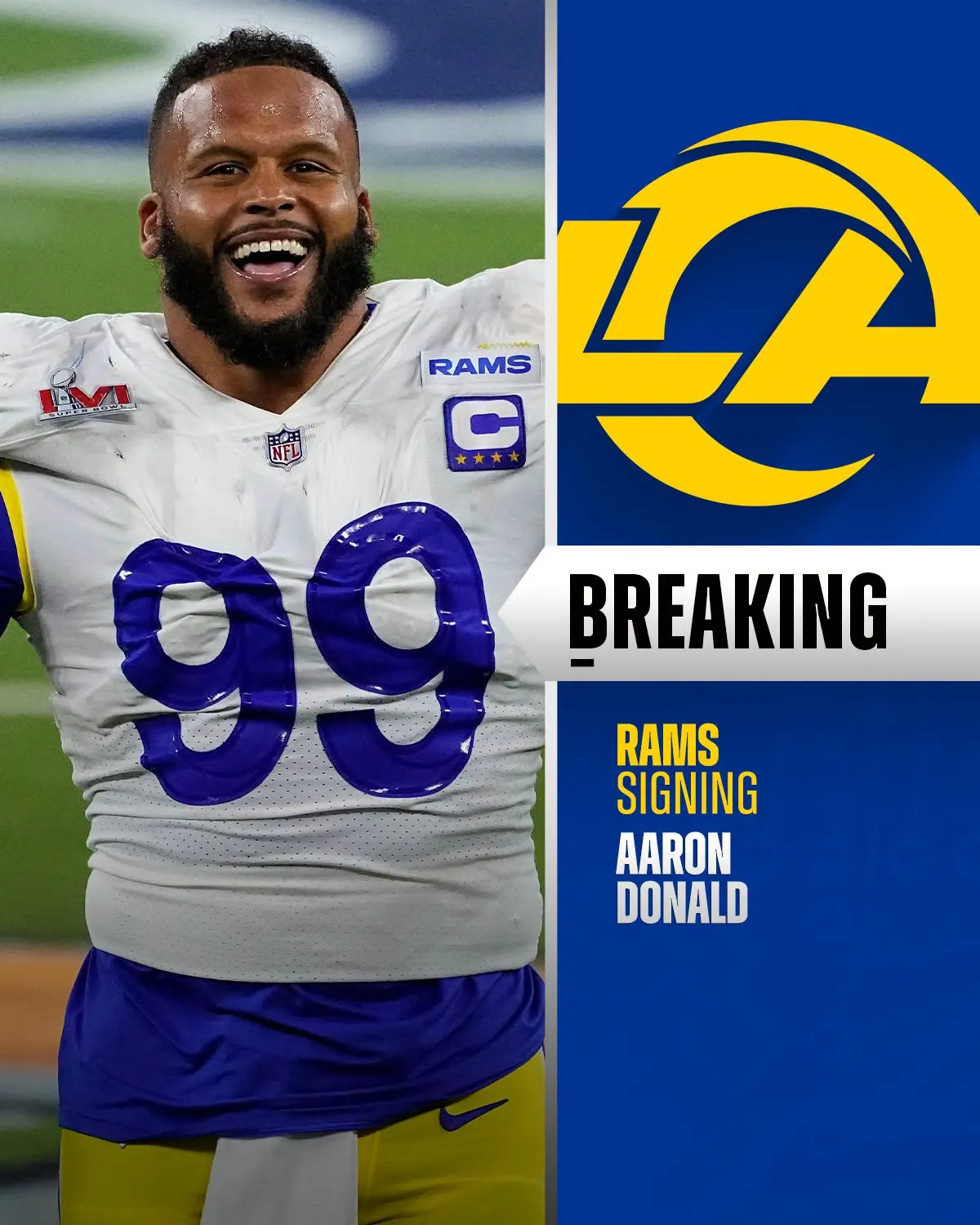
NFL Hall of Fame player, Aaron Donald, is actually returning to the Rams!
The Hall of Fame induction will be pushed back two or three years because future NFL Hall of Fame player, Aaron Donald, is actually returning to the Rams. Don’t get me wrong, I am wrong about a lot but man was this shoved back in face to be nicer because it was shoved elsewhere considering how wrong this became and honestly, I am not shocked anymore. What is now more than two years from his initial retiring and after we then spent months watching him slowly but sure trickle his way back onto the team. It became real when TMZ took that footage of him on the actual practice field. I then wondered how much he stayed in shape because I know then he started to work out or better yet, he started training for the team.
And, because of how busy I was over the last three weeks and a weekend of constant IT work that just put me out of the writing game those days and weeks. Because in that world of coding, 7 hours goes by at the blink of eye. I then started to write about last Thursday’s game on Friday before that site imploded again, which was against the San Diego Chargers who also calls our stadium as their home, which I hate. The Stadium looks weird when they are in it as the home team. Let alone against the Rams is just odd.
That game went well in the sense that we had no starters play as far as I know play any of the game and not only that, the 3rd and 4th spot players also played most of that game. Ty Simpson played the entire first half. Stetson Bennett sat and then Matthew Caldwell played most of the second half until he got injured. His knee is in bad shape and therefore, it makes dropping a quarterback very easy because we placed him on the injured reserve for the entire 2026 season.
Therefore, our Quarterbacks are set. For now, Ty Simpson will be the third stringer and even though he will be the 2nd string QB in due time and moreover, I am good with him at the Quarterback. He won me over because of his arm strength. I mean zero offense toward Stetson Bennett and his play at all, it’s a different style all together but again, Simpson’s arm is huge. He has a line on that ball like any major quarterback has had or has today.
I did however, see a ton gaps no pun intended, with regard to the Offense Line. It was the first time a Defense was able to tackle a running back for less than 5 yards all preseason. Plus, defenders found those lanes to be able to snag a few players in the backfield but again, we literally had the 3rd, 4th and 5th string players in the entire game as far I know.
With that said, did I mention that the three-time NFL Defensive Player of the Year is coming out of retirement which in a beautiful world, will make this Rams Defense unstoppable. I am very curious now to see that deptch chart. Let’s look at it:
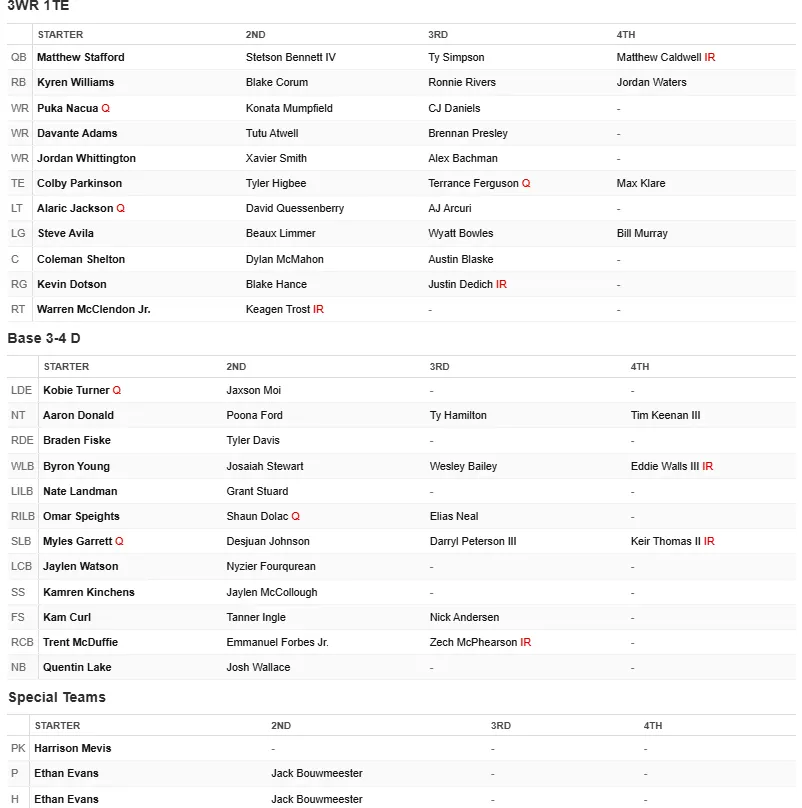
This confirms what I was getting at because the trade off is clear. Is Aaron Donald a better Defensive Lineman than Poona Ford. I honestly did not think it would be more than that one player being affected however I was also wondering if they syhifted things and moved him around. There were reaklly not any other ways to manuver this to be perfect. Therefore, when you look at it that way, the $20,000,000 one year deal is a bit more viable even though i have no clue where we rea getting that money. I did not think we had more than $15,000,000 to play with after June’ish this summer. Donald by the way, is now 35, signed this deal that can be worth up to $30 million with playoff incentives.
“To be honest with you, it was on and off for a little while, but I think I knew this decision about two weeks ago,” Donald said. “I know the world was saying all types of things and nobody knew what was going on, but I kind of knew for two weeks. I talked to Sean every single week, damn near every day. We stayed in contact. I’d give him all my updates of how I was feeling, how things was going.
“I was doing everything I needed to do to get myself some peace of mind to see if I can do it. Wasn’t no rushing. Just wanted to take my time and make the decision because once you choose to come back, you’re all the way back in.”
What I want to come of this is the second coming of the Fearesome Foursome.
Shortly after the Los Angeles Rams acquired Myles Garrett in a trade with the Cleveland Browns on June 1, a Donald comeback seemed like little more than a long shot.
That fantasy scenario quickly started looking a lot more real, with McVay speaking often on the prospect in a positive light, while still leaving the decision in Donald’s hands. Things picked up steam when Donald had an official tryout on Aug. 5, as noted on the league’s transaction wire. Donald, who had already visited the Rams’ facility a few times before, worked out in a helmet but without full pads. Because he used team equipment, the Rams were required to report the session to the league. Los Angeles reported a second tryout on Aug. 16.
Donald is indeed rejoining the Rams, this time in full pads, adding even more depth to an already stacked roster and giving the defensive line a case for being called a new-age Fearsome Foursome. What’s still unclear is when he’ll actually take the field with the group. McVay told reporters Sunday that L.A. hasn’t yet decided whether Donald will suit up for the season opener against the San Francisco 49ers in Australia. I really hope he gets into that game and then we can move onward without interruption.
Together, Donald and Garrett bring a combined 17 Pro Bowl selections, 13 All-Pro honors, 236.5 sacks and, most impressively, five combined AP NFL Defensive Player of the Year awards to the table. There was a point in our Super Bowl Championship win where Donald and that defense would just devour the Offensive Line and their Quarterback like a triangle of people swarming the entire team pushing them backward all the time. I wondered if a team could even get up to that high level of control ever again and I never really saw it before. It’s hard to explain because the entire offense would just buckle from the entire Defense just manhandling these teams’ Offenses.
Garrett, who won his second career Defensive Player of the Year award last season after setting an NFL single-season sack record with 23, was already seen as the focal point of what was a remarkable Rams offseason. Donald’s un-retirement pushes L.A.’s status as Super Bowl favorites into an entirely new stratosphere.
Here’s where things get interesting. Maybe it’s less a Fearsome Foursome now and more a Fearsome Fivesome, given how defenses across the league are built today, with that extra Edge rusher or glorified Outside Linebacker spot that just didn’t exist back in the day. Hardly any teams still line up with only 4 defensive linemen like they did in the sixties. L.A.’s front is deep: Braden Fiske has 11.5 sacks over two seasons, Byron Young made the 2025 Pro Bowl with 27.5 sacks in three years, Poona Ford holds down the run defense, and Kobie Turner closes out the group with 24 sacks in three seasons. He’s dealing with an injury heading into camp, and it looks like that’ll stick around through it.
One elite pass rusher Donald won’t get to line up alongside is Jared Verse, who went to Cleveland as part of the Garrett deal. Verse once joined a then-retired Donald for one of his legendary workouts and came away calling him a “psychopath” after losing a challenge to him. Nobody’s questioning whether Donald has stayed in shape, but whether he’s in true “football shape,” and how much rust he needs to shake off, will be storylines to watch. So will the sheer anticipation of what he’s still capable of.
Plenty of NFL defensive lines have carried the “Fearsome Foursome” label over the years, but none is more legendary than the Rams’ own, Hall of Famers Deacon Jones and Merlin Olsen, alongside Rosey Grier and Lamar Lundy, with Roger Brown joining later. Many still call that group the greatest defensive line the league has ever seen, but it played in the pre-Super Bowl era and never got the Rams to an NFL Championship Game.
For this new version of a frightening front, the measuring stick will be February.
Super Bowl LXI lands on Feb. 14, 2027, at SoFi Stadium in Inglewood, California, the Rams’ own backyard. It’s the same stadium where Donald and the Rams claimed their greatest moment.
Donald sealed that Super Bowl LVI win with an unforgettable 23-20 victory over the Cincinnati Bengals, sacking quarterback Joe Burrow on a fourth-down incompletion, capping off a second-half defensive masterclass that also included a third-and-1 stop for no gain the play before.
A lot has changed since that championship roster. Odell Beckham went back to the New York Giants, Jalen Ramsey landed with the Pittsburgh Steelers, Ernest Jones and Super Bowl LVI MVP Cooper Kupp are now Super Bowl champions themselves with the rival Seattle Seahawks, and veterans like Andrew Whitworth and Rob Havenstein have since retired.
Donald, though, is coming back. He’ll be the lone starter left from that championship defense, rejoining just a handful of teammates who won it all alongside him: Tyler Higbee, Alaric Jackson, Coleman Shelton, and reigning NFL MVP Matthew Stafford.
Donald is not only a future Pro Football Hall of Famer, he induction will now have to wait up to three more years since you need to be retured for five full year. He will now go back ground zero and therefore, he would have been eligible for induction in 2029. Now, he’ll push his candidacy back five years from whenever he plays his final season.
Donald has played 10 NFL seasons, which began with him winning the 2014 AP NFL Defensive Rookie of the Year. Donald has gone to the Pro Bowl every year, has won three DPOY honors and has earned All-Pro recognition eight times, while producing 111 sacks (career-high 20.5 in 2018), 543 tackles, 24 forced fumbles and 176 tackles for loss while earning a spot on the Hall of Fame’s All-2010s Team.
On June 1 when Garrett was acquired, Donald first teased a comeback, posting a workout video on Instagram featuring Bixst’s “Ain’t Done” and captioned “#ready.” His daughter did say that ‘Y’all are crazy’.
L.A. traded for cornerback Trent McDuffie in a trade with the Kansas City Chiefs, signed him to an extension and also signed his longtime K.C. teammate Jaylen Watson.
Overall, anything less than a championship is a failure. But I had that expectation with or without Aaron.
The next steps for me to be a real believer is to now to get some glimpses of his play. If the decision is to whether to play Aaron Donald or Poona Ford, for now and again, to me, that is an easy decision for now at least.
Legal drama, roster crunch, and kickoff countdowns — today’s biggest stories across every sport. Wednesday, August 26, 2026 The Scoreboard
Source: Legal drama, roster crunch, and kickoff countdowns — today’s biggest stories across every sport.
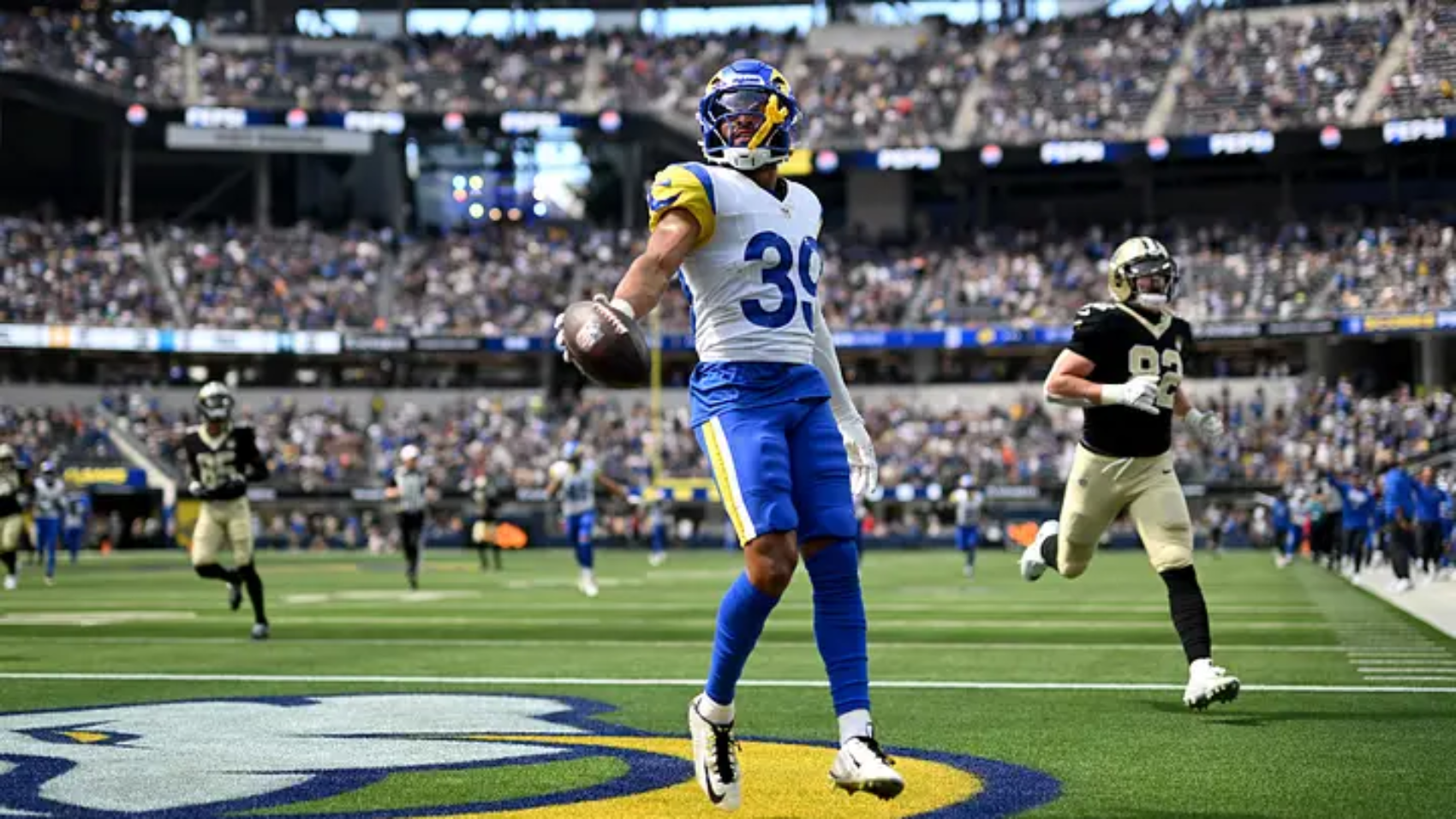
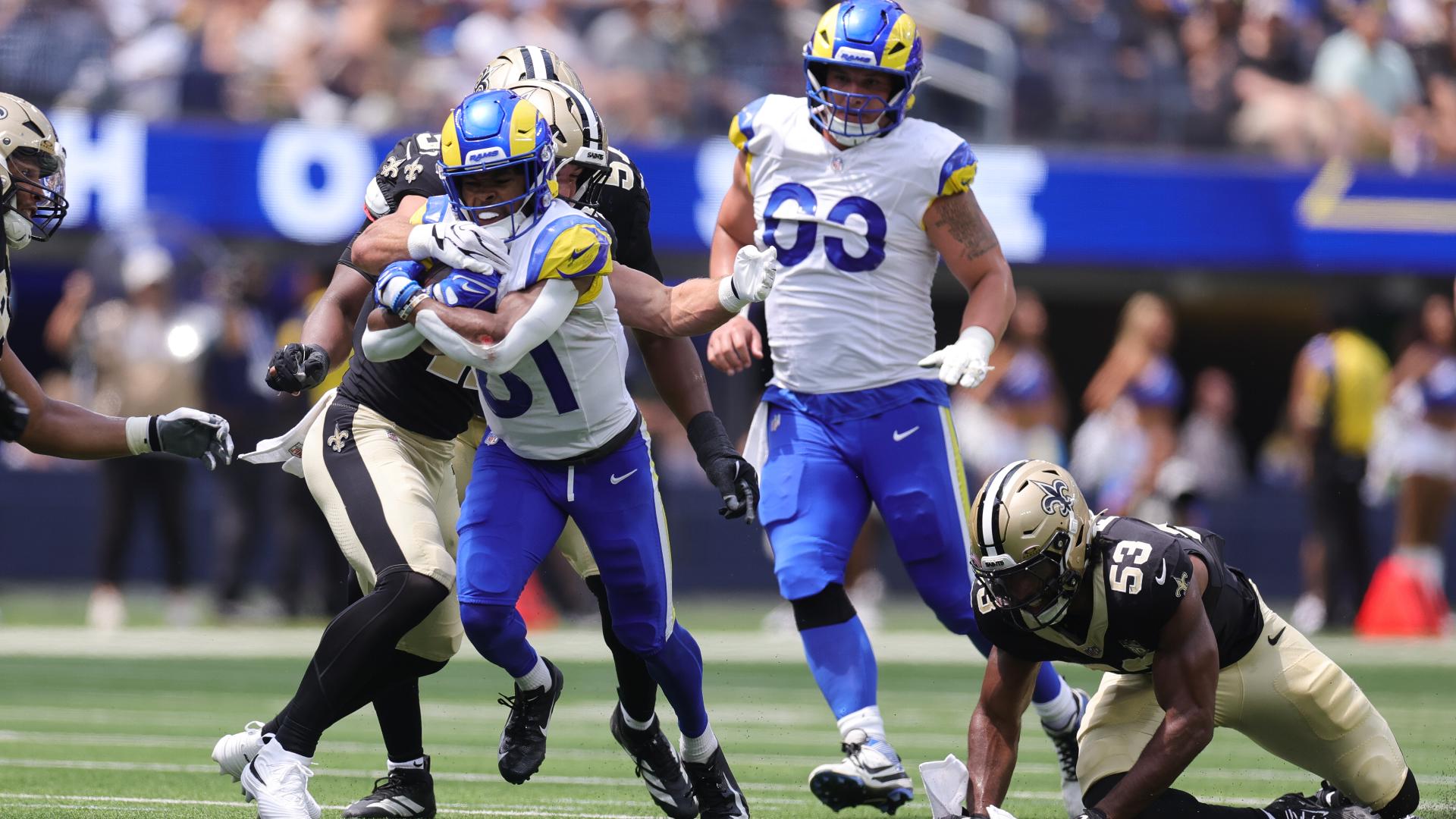
The Los Angeles Rams delivered the most complete performance of their preseason on Saturday night at SoFi Stadium, shutting out the New Orleans Saints 34 to 0 in a game that was effectively decided by halftime and only grew more lopsided from there. It marked the first time this franchise has posted a preseason shutout since at least the year 2000, and the manner of it, two takeaways in the red zone, a near flawless half from the presumptive backup quarterback, and a defensive performance that made two entire units look overmatched, did as much to complicate the upcoming roster cutdown as it did to build momentum heading into the regular season.
Stetson Bennett played the entire first half and left no real doubt about where the backup quarterback competition currently stands. He completed nineteen of thirty one passes for one hundred eighty one yards, and while he did not throw a touchdown through the air, he did not need to. He dove into the end zone from the one to open the scoring, then added an eight yard scramble later in the half for his second rushing touchdown, both scores coming on his only two carries of the night, exactly nine yards worth of work that produced fourteen points. Bennett has now strung together strong preseason showings across four seasons on this roster without ever appearing in a regular season game, and this one, by his own account, felt like his most comfortable outing yet, the product of a staff that has spent all camp reminding him to tuck the ball and run when his first read isn’t there.
Rookie receiver CJ Daniels needed a game like this after managing only two catches in the preseason opener against Kansas City. He got it, hauling in eight receptions for sixty eight yards on a team high twelve targets, easily his most productive outing of the summer and a real answer to anyone wondering whether last week’s quiet night was cause for concern.
With New Orleans controlling much of the time of possession in the third quarter, rookie Ty Simpson only saw three offensive series in relief of Bennett, but he made the most of them, completing eight of twelve passes for seventy three yards and leading a scoring drive of his own. It was a smaller sample than his impressive debut against the Chiefs, when he went twenty one of twenty five for one hundred ninety yards and two touchdowns, but the efficiency carried over, and there is nothing in these two performances suggesting the coaching staff is anything but pleased with how he’s developing behind the top two arms on the depth chart.
The single biggest play of the night belonged to safety Alex Cook, and the story behind it matters as much as the play itself. Late in the third quarter, with New Orleans driving and threatening to finally get on the board from the Rams’ six yard line, quarterback Spencer Rattler tried to thread a pass to his tight end in a tight window at the goal line. Cook read it from the snap, stepped in front of the throw, and turned upfield with nothing but open grass in front of him, finishing a one hundred yard interception return that pushed the lead to twenty seven to nothing with just over nine minutes left in the quarter.
Cook signed with the Rams on July 27 as one of the more well traveled players on this roster. The twenty seven year old out of Washington went undrafted, caught on briefly with the Giants across two separate stints in 2023 and 2024, then appeared in ten games for Carolina before his NFL opportunities dried up. He spent this spring with the Birmingham Stallions in the UFL, where he racked up forty five tackles, six pass breakups, an interception, and a fumble recovery, production that earned him a third chance in the league. Saturday’s touchdown was the realization of something Cook has apparently been chasing for a while, and it instantly reframed the entire conversation around the back end of this secondary.
If Cook provided the highlight, outside linebacker Wesley Bailey provided the substance. The undrafted rookie out of Louisville, by way of a transfer from Rutgers, finished with five tackles, a tackle for loss, a sack, and four quarterback hits, but the number that actually stopped people mid scroll was his pressure count. Bailey generated ten total pressures on the night, twice as many as any other player in the game, a total that only a handful of players across the entire league have reached in a preseason contest since 2023. His signature moment came late in the third quarter as well, tracking down running back Ty Chandler inside the five yard line and punching the ball loose before it could reach the end zone, a takeaway defensive lineman Payton Zdroik recovered to end the threat entirely. Head coach Sean McVay didn’t hold back afterward, saying there are certain players whose presence you simply feel on the field all day, and that Bailey was exactly that on Saturday.
The secondary had its own moments worth noting too, tying directly into a roster battle that’s been building all camp. Al’Zillion Hamilton picked off a pass of his own early in the second quarter, and Cam Lampkin, who has spent this camp fighting for the final cornerback spot on the roster, added an impressive fourth down pass breakup with just over seven minutes left in the first half. Neither takeaway wiped out a full possession the way Cook’s did, but both are exactly the kind of plays that keep showing up on tape when roster decisions get made.
The ground game finally looked like what the coaching staff has been building toward. Jarquez Hunter and Jordan Waters combined for twenty two carries and one hundred twenty two yards with a touchdown, and the line in front of them didn’t allow a single sack all night while averaging five yards a carry as a group. Hunter did the heavier lifting this time, turning twelve carries into sixty eight yards and a score, which pushes his two game preseason total to one hundred three yards on the ground. Waters added fifty four yards on ten carries of his own, bringing his own two game total to ninety one. With right tackle Keagen Trost still working back from the hamstring injury he suffered in the opener, backup Sam Blaske stepped into that spot again and held up well in both phases, giving the coaching staff a genuinely encouraging look at its depth up front.
Part of Saturday’s broadcast came from an unexpected source. Actress Brenda Song, a longtime Rams superfan who is engaged to actor Macaulay Culkin, joined the CBS Los Angeles booth for the third quarter alongside play by play voice J.B. Long, The Athletic’s Jourdan Rodrigue, and former Rams lineman Rob Havenstein, marking her debut as a color analyst. Her enthusiasm was on full display the moment Cook crossed the goal line on his interception return, and while reactions to a first time broadcaster in that seat were mixed across social media, there was no arguing with the timing. She got to call the single biggest play of the game in her very first outing behind the mic.
A win this lopsided does not make the roster any easier to finalize. It makes it harder. Los Angeles currently has four backs, Kyren Williams, Blake Corum, Jarquez Hunter, and Jordan Waters, who look like they could start somewhere in this league, and only so many spots to keep all of them happy. At receiver, with Xavier Smith sidelined this week and already presumed to hold one of the final spots, the fight for the fifth and sixth jobs between Daniels, Alex Bachman, and Brennan Presley remains genuinely unresolved, and how the coaching staff weighs live game production against long term developmental investment in a draft pick like Daniels will say plenty about this front office’s priorities once the roster actually gets trimmed.
Then there’s the problem Cook and Bailey created for themselves by playing so well. Both would normally look like players trying to sneak onto a sixteen man practice squad, but performances like these tend to get noticed by all thirty two front offices, not just the one doing the cutting. The outside linebacker room only complicates that further, with Keir Thomas II working through a groin injury he suffered earlier in this same game, thinning out a group that already had real competition at the bottom of the depth chart before Bailey forced his way into the conversation.
Signed July 27 out of the UFL. A hundred yard pick-six makes him a genuine 53-man consideration, not a practice squad afterthought.
Undrafted out of Louisville. Ten pressures and a forced fumble in one game make him nearly impossible to expose to waivers.
Even the quarterback room factors into the math. Keeping three arms, Matthew Stafford, Ty Simpson, and Stetson Bennett, protects Bennett from waivers entirely, but it also means that roster spot has to come from somewhere else on an already deep team. That’s the actual story of this preseason at this point. Not whether the Rams are good enough, but how many good players this roster can actually afford to keep.
Los Angeles closes out its preseason slate at home against the Chargers before turning fully toward the season opener, a first of its kind trip to Melbourne to face San Francisco on September 10. The scoreboard from Saturday says 34 to 0. The roster meetings this week will be a lot closer than that.
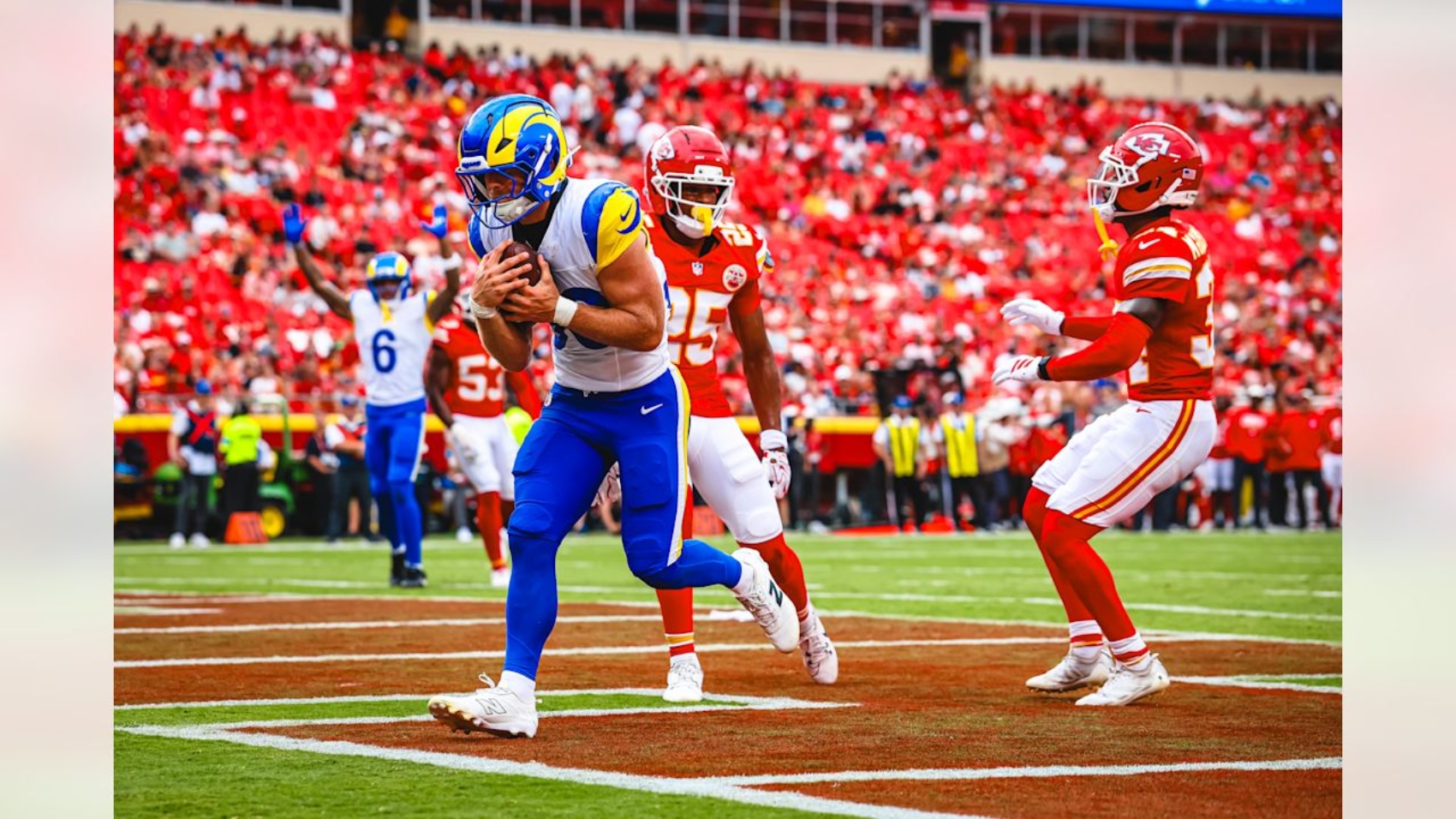
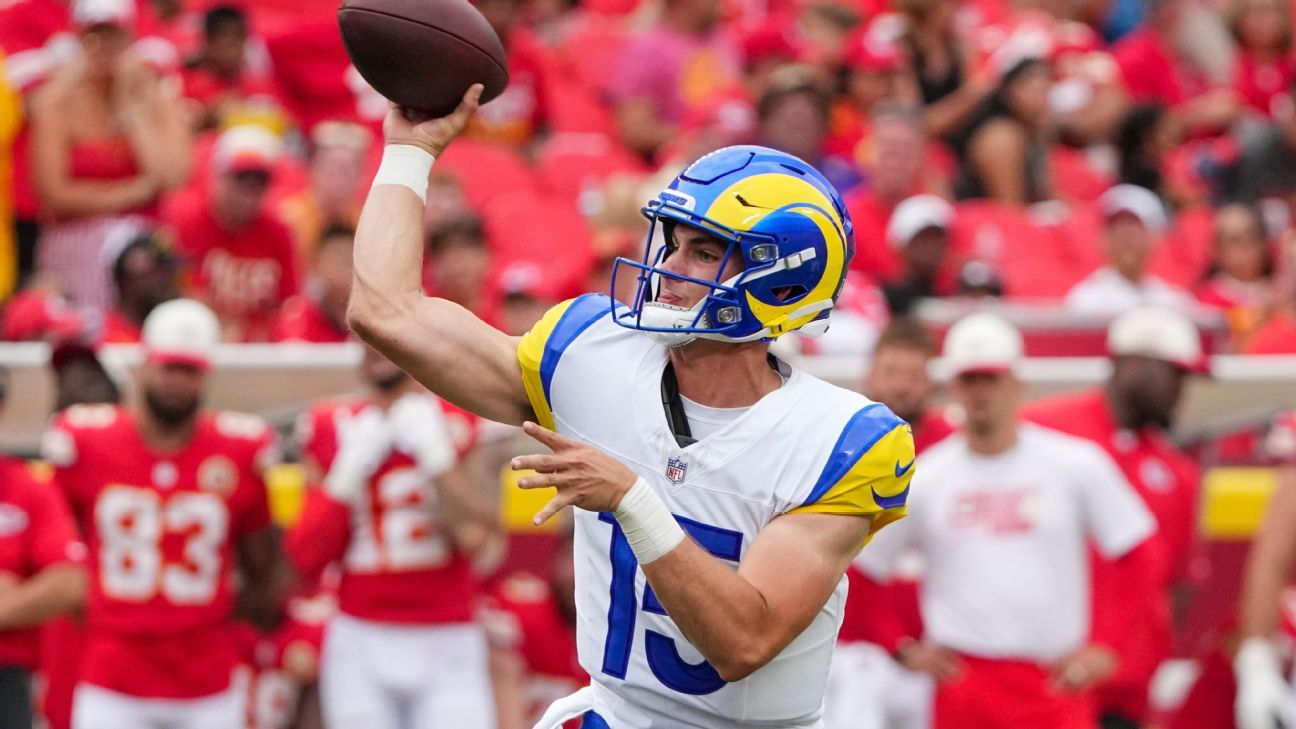
I’ll be honest, I started this week’s piece about eight different times, because by every normal standard, I genuinely don’t have anything negative to point out. This second and third string group could line up against a real chunk of this league right now and hold its own, and that’s not a sentence I expected to write in mid August.
The one thing that actually caught my attention had nothing to do with the Rams at all. Kansas City’s broadcast is a strange watch if you’re not used to it, Trent Green calling the game as their color commentator now, and somewhere in there I ended up watching one of their sideline interviews after a rookie’s series. What stood out wasn’t the interview itself, it was the hug at the end of it. Then I noticed it again with the next player. That tight, almost family style rapport between that sideline reporter and every single player she talks to, regardless of whether they’ve built any real relationship yet, is something I genuinely don’t remember seeing anywhere else, not with the Rams’ own sideline reporter, not in Philadelphia, not anywhere I can actually recall. I don’t know if that’s a Kansas City thing or just how that particular broadcast operates, but it’s a nice touch, and it stuck with me more than most of the actual football did.
On the field itself, I want to circle back to that backfield one more time, because I mean this genuinely, I didn’t know either of those two names walking into Saturday night, and by the end of it I was fully bought in. Aside from the one stretch where the line was still sorting itself out, they found room on basically every carry, and the offensive line deserves real credit for that once it settled down. And Simpson, I’ll just say it plainly, that arm is legitimate. He wasn’t pushing the ball deep all night, but those fifteen to twenty eight yard completions were placed perfectly all evening, and he ran this offense with almost no hesitation for a guy who only checked in early in the second quarter. I walked away from this one genuinely impressed, and I don’t say that lightly about a preseason opener.
Preseason RecapThe Los Angeles Rams opened their preseason with exactly the kind of game a coaching staff actually wants from week one, tight enough to force real decisions out of backups and rookies, and ultimately decided by which team’s kids held up better once the pads mattered. Los Angeles left Arrowhead Stadium with a 20 to 12 win over the Kansas City Chiefs, a result built almost entirely in the fourth quarter after four periods of the two sides trading field position and short drives that refused to break for most of the night.
Both coaching staffs kept their marquee names on the sideline to open things, letting the players fighting for actual roster spots set the tone early. Stetson Bennett took the first snaps for Los Angeles and opened with a three and out, hardly the start anyone wanted, before steadying into a genuinely impressive answer, a thirteen play drive covering seventy three yards that kept him in rhythm in the pocket for more than six minutes of clock. It ended not in the end zone but with a twenty five yard field goal from Harrison Mevis, enough to put the Rams up three to nothing and, more importantly, enough to show that Bennett’s control of the offense has not slipped with the calendar turning toward the regular season.
The only real gut punch of the night came on that same opening series. Rookie right tackle Keagen Trost, who had spent the back half of camp auditioning for real interior line snaps, went down with a significant hamstring injury and did not return, forcing Blake Hance into extended duty at right tackle for the rest of the exhibition. It is the one injury from this game that actually carries weight beyond the preseason box score, and how quickly Trost recovers will matter for a coaching staff that had already started leaning on him for depth before the pads ever came on in earnest.
Kansas City handed the offense to seventh round rookie Garrett Nussmeier in the second quarter, and he answered with a genuinely composed drive downfield, one that briefly looked like it would produce the game’s first touchdown when running back Emmett Johnson burst through the line and raced into the end zone. The play never counted. An offensive holding penalty wiped it off the board entirely, forcing Kansas City to settle for Harrison Butker splitting the uprights from thirty one yards to level the score at three apiece. Los Angeles answered almost immediately once first round rookie Ty Simpson entered the game on the offense’s third series, rolling smoothly outside the pocket to buy himself room before setting up another Mevis field goal, this one from forty yards, to push the Rams back in front six to three. Nussmeier matched him one more time before the break, orchestrating a crisp two minute drill that ended in a screen to tight end Jake Briningstool, and with just four seconds left on the clock, Butker connected again from thirty five yards to send the two sides to the locker room tied at six.
The third quarter belonged almost entirely to field position and physicality rather than points. Both offenses traded stops and punts to open the half before Kansas City finally broke through with an old fashioned, clock eating answer, an eleven play drive that covered fifty four yards almost entirely on the ground. The possession stalled at the Rams’ forty one yard line after a false start on fourth and one bailed out the Los Angeles defense, but Butker answered anyway, drilling a remarkable fifty nine yard field goal to put the Chiefs in front nine to six heading into the fourth.
Everything that decided this game happened in the final period, and almost all of it ran through special teams and Ty Simpson. A three and out forced by the Rams defense, punctuated by a thirteen yard sack of Nussmeier, flipped the field, and Xavier Smith turned the ensuing punt into a forty yard return that handed Los Angeles the ball inside Kansas City’s twenty three yard line. Simpson needed only a handful of plays to cash it in, hitting rookie running back Dean Connors on a nine yard touchdown pass that put the Rams back on top thirteen to nine. After a quick defensive stop gave him the ball back, Simpson got genuinely hot, carving up Kansas City’s reserve secondary with a string of downfield completions covering twenty two, thirteen, twenty three, and sixteen yards before finishing the drive with a two yard strike over the middle to Connors, his second touchdown of the night, stretching the lead to twenty to nine and putting the game firmly out of reach.
Kansas City turned to backup Chris Oladokun for one last push, and running back Jaydn Ott did most of the work on the ground and through the air, hauling in receptions of thirteen and twenty seven yards to move the offense into Rams territory. The drive stalled at the Los Angeles eight yard line, and Butker closed the scoring with a twenty six yard field goal to make it twenty to twelve. An onside kick attempt from Kansas City came up empty, and Jordan Waters iced the game moments later with a twenty six yard run that let Simpson take a knee and walk off with the win.

Whatever else gets said about this opener, the running game deserves its own paragraph. The coaching staff leaned on a heavy, traditional rotation, giving each back an extended look to evaluate vision and pass protection rather than settling on one clear lead option. Jordan Waters was the most explosive of the three, finishing with five carries for thirty seven yards, and he saved his best for last, gashing the middle of Kansas City’s defense for a game sealing twenty six yard run on the final drive that let the offense simply kneel out the clock. Jarquez Hunter played the traditional bell cow role for most of the second and third quarters, grinding out nine carries for thirty five yards between the tackles and consistently falling forward for positive yardage, exactly the kind of unglamorous work that kept both rookie quarterbacks out of long down and distance situations. Dean Connors had a quieter night on the ground, managing five carries for just eleven yards behind a shuffled offensive line, but he made up for it entirely through the air, catching four passes for twenty nine yards and scoring both of the Rams’ fourth quarter touchdowns.
Simpson added his own dimension to the ground game as well. He scrambled out of the pocket on three separate occasions when his downfield targets were covered, picking up twenty one rushing yards in the process, including a sharp eleven yard dash out of bounds that kept a drive alive on its own. None of it happened in a vacuum, either. The line spent the first half adjusting to Keagen Trost’s early exit, and Blake Hance’s sudden shift over to the right side produced a handful of communication breakdowns against Kansas City’s front that showed up as early run stuffs before the group finally settled in. Once it did, that backfield started finding room on almost every snap, which says as much about the five in front of them as it does about the backs themselves.
Strip away the final score and this was a far more even fight than twenty to twelve suggests on the surface. Los Angeles finished with three hundred and twenty one total net yards to Kansas City’s three hundred and fourteen, essentially a wash. The Chiefs were also considerably sharper on third down, converting seven of sixteen chances compared to just two of eight for the Rams, which under normal circumstances would be enough to tilt a game in the other direction entirely. What actually decided this one was discipline. Los Angeles was flagged a single time all night for fifteen yards, while Kansas City picked up twelve penalties for eighty three yards, repeatedly putting themselves in longer down and distance situations and helping erase drives that otherwise had real life in them.
Simpson’s final line tells its own story regardless of what the rest of the box score says, twenty one completions on twenty five attempts for one hundred ninety yards, two touchdowns, and no interceptions, an efficient, mistake free outing for a rookie getting his first taste of live snaps against a real opponent. Bennett’s brief outing, four of six for thirty eight yards, was more about rhythm and ball security than volume, and it did exactly what it needed to do before handing the keys over.
None of this changes very much about how the regular season shapes up, and nobody in that building is going to pretend otherwise. But for a preseason opener, Los Angeles got exactly what it needed, real answers from its quarterback room, a proof of concept for a rookie class already earning trust, and a reminder that even in August, discipline decides more games than talent alone.
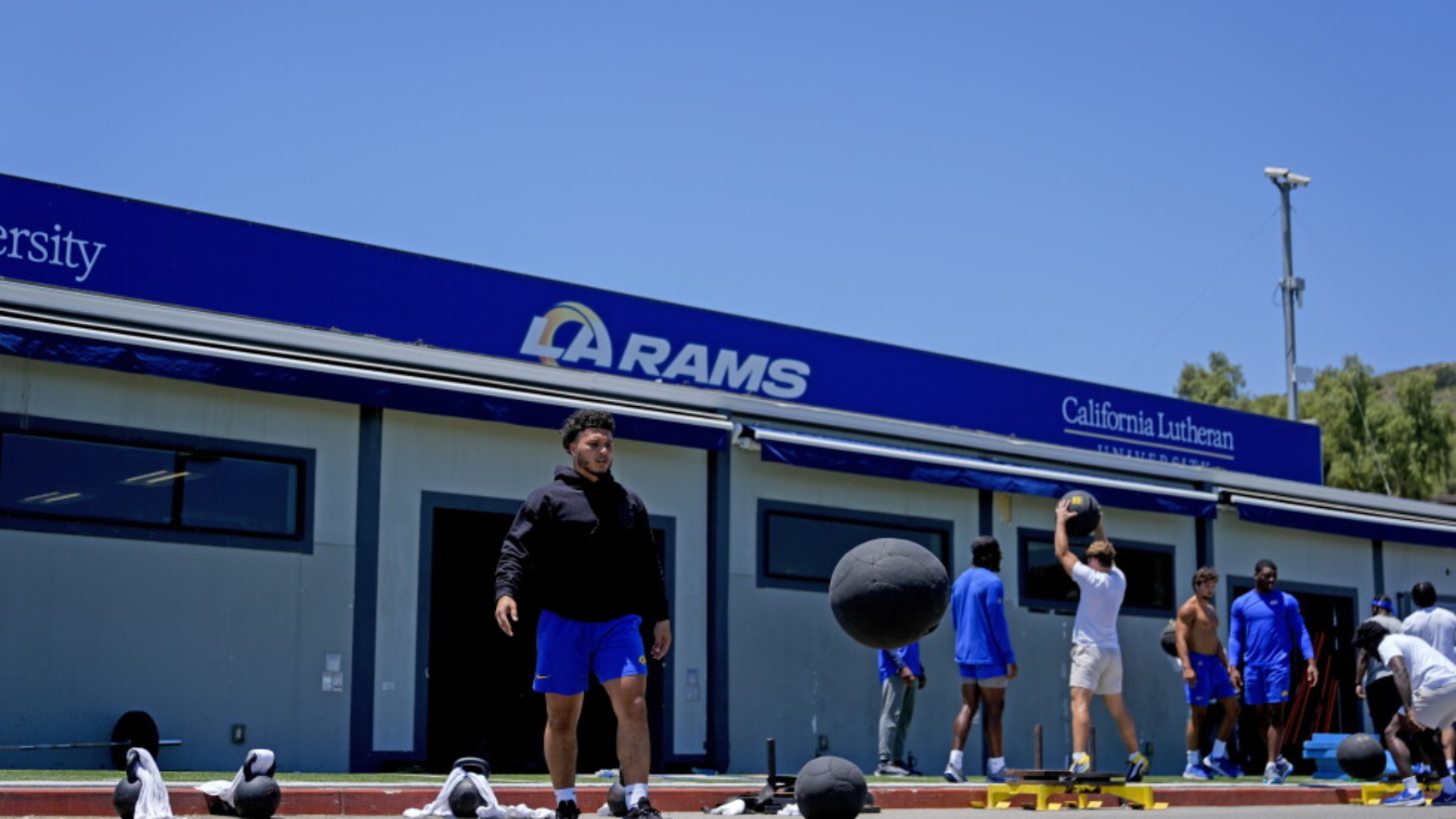
Camp is over. Thursday was the last real practice at LMU. Friday was a closed, non-contact walkthrough. Now it’s game-week prep in Thousand Oaks ahead of Saturday’s preseason opener against the Chiefs. We’ll know so much more during that game, and the beauty of it is that what we watch matters this year. We’ll get our first look at the potential new wide receivers. We will see how each Quarterback throws for real and they should both get many snaps and probably the same amount of snaps. I’m not sure if any starters will play. I’m thinking not, and therefore, we likely won’t get to see the defensive backs playing against their old team. I hope none of the other starters play.
The Aaron Donald watch is still happening. McVay addressed the Donald situation again at the team’s Woodland Hills facility. His answer sounded almost identical to every answer before it, “He looked great, still going through his process, no new news on an actual decision.” They’re still not announcing anything, and then I heard that Donald worked out separately with Braden Fiske. That, I liked to see if that really happened. Fiske has talked during this camp about what the new-look defense could become. And as you all know about my feelings on it, I wish we weren’t talking about it.
I did hear of something called a “Blueprint” with regard to getting him going, but I’m not sure how real it is and nor do I know what it is but was about Donald’s entry way back to the team. Maybe a step by step process. LOL. Read the Full Article on the Los Angeles Rams Substack!
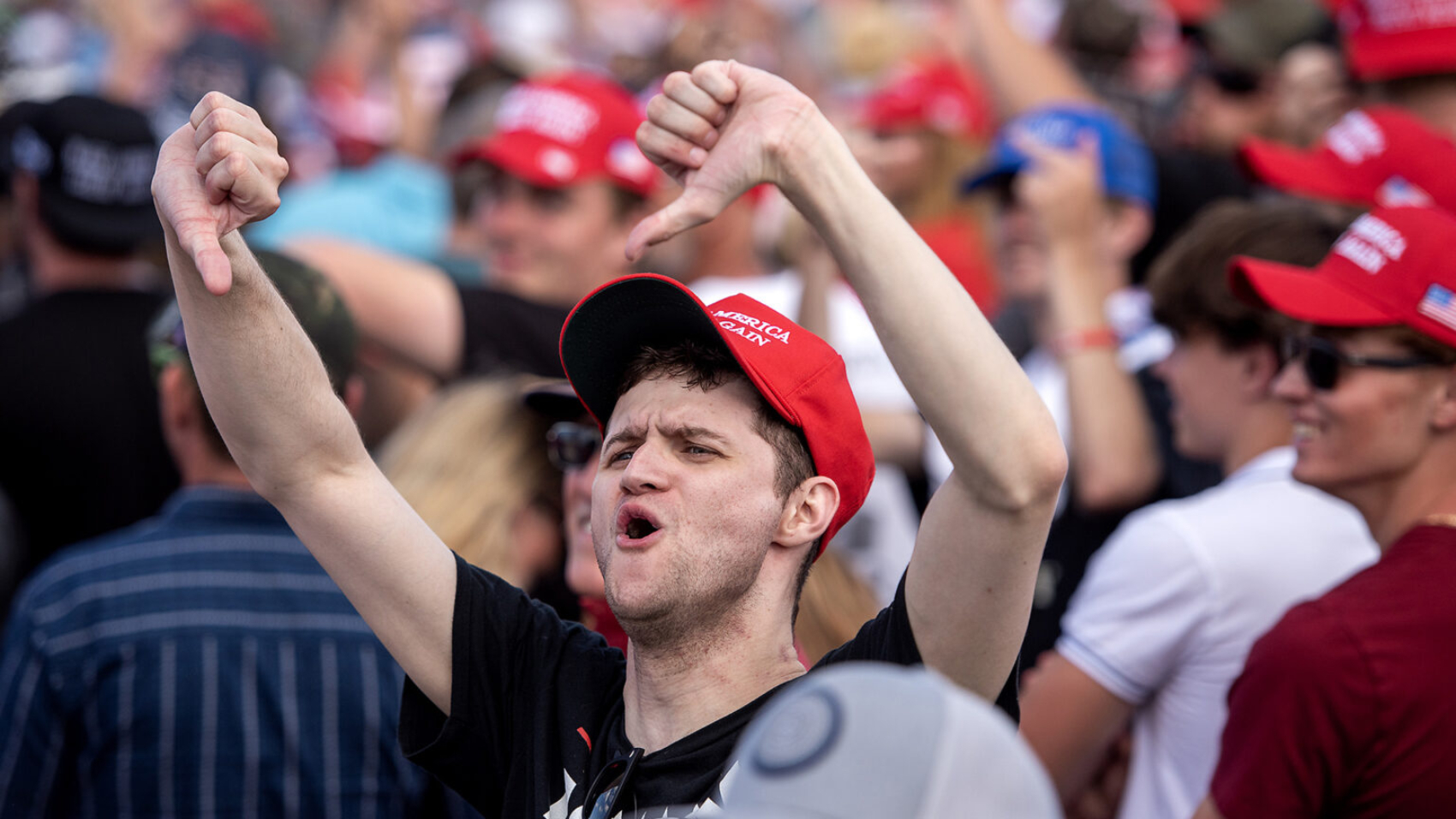
‘Oh, oh oh oh, Idiots Rule’, The Power of Low-Information Voters in Modern American Politics
Source: ‘Oh, oh oh oh, Idiots Rule’, The Power of Low-Information Voters in Modern American Politics
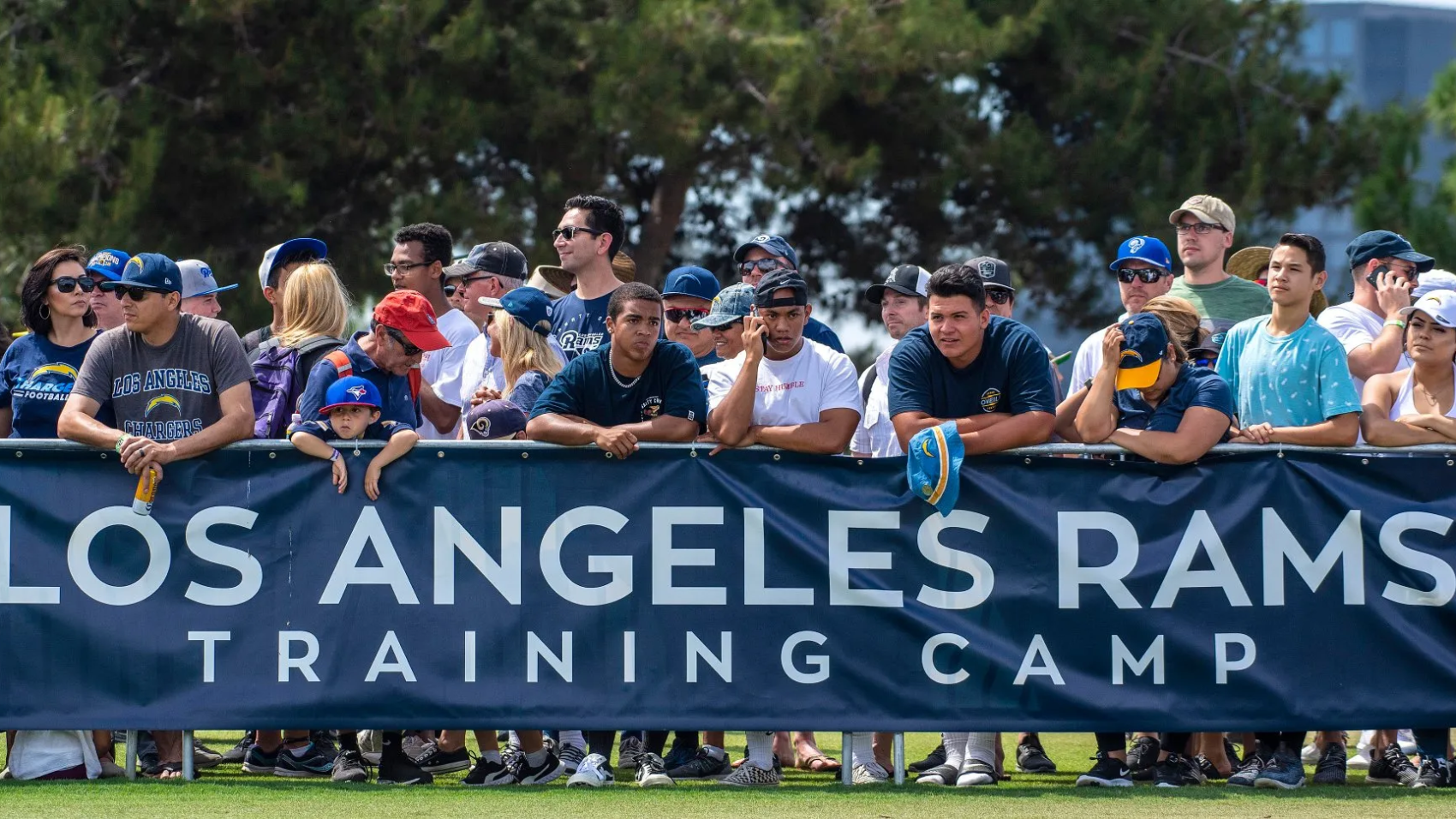
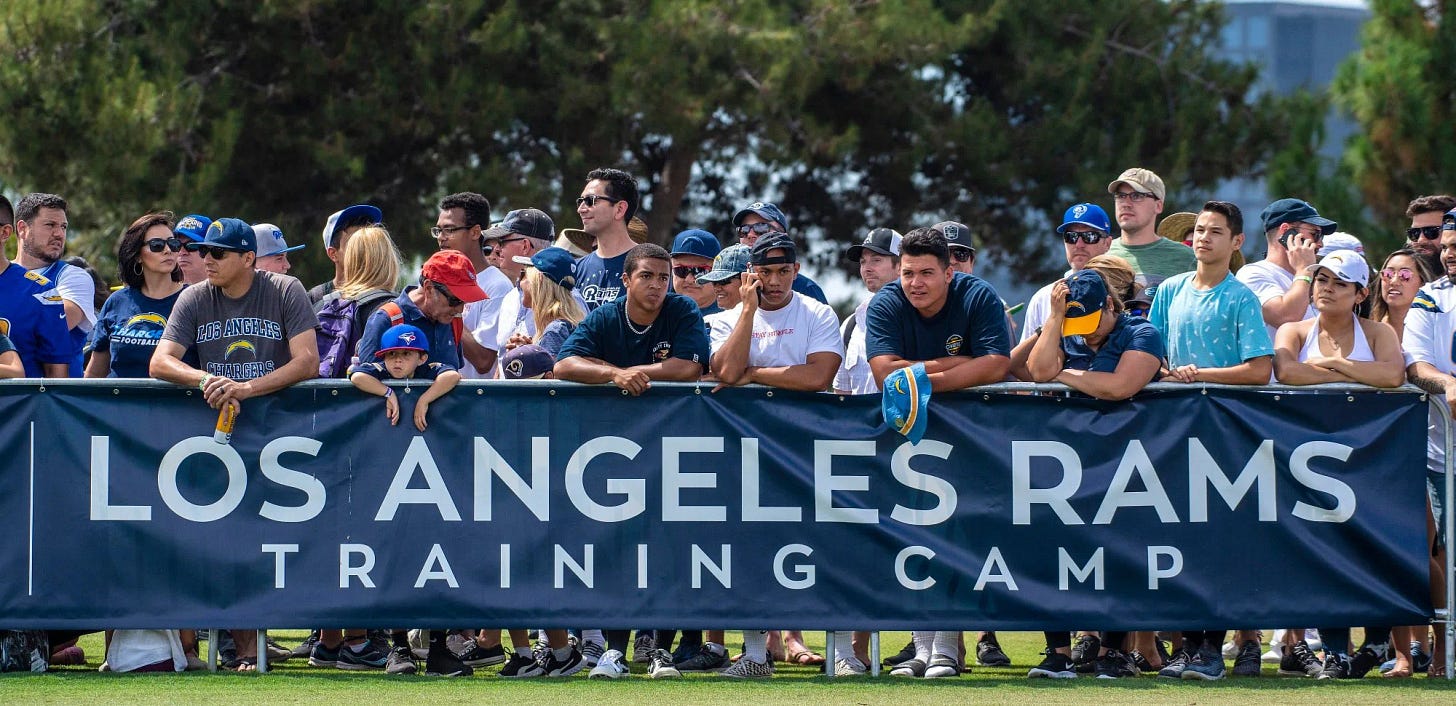
Pads will be on this weekend finally. The buildup was appropriate, as the four-day block of camp leading into this weekend had me more interested than I expected going into the season. Let’s get to what actually happened in the back half of the first block since our last post. Read the Full Article on the Los Angeles Rams Substack!
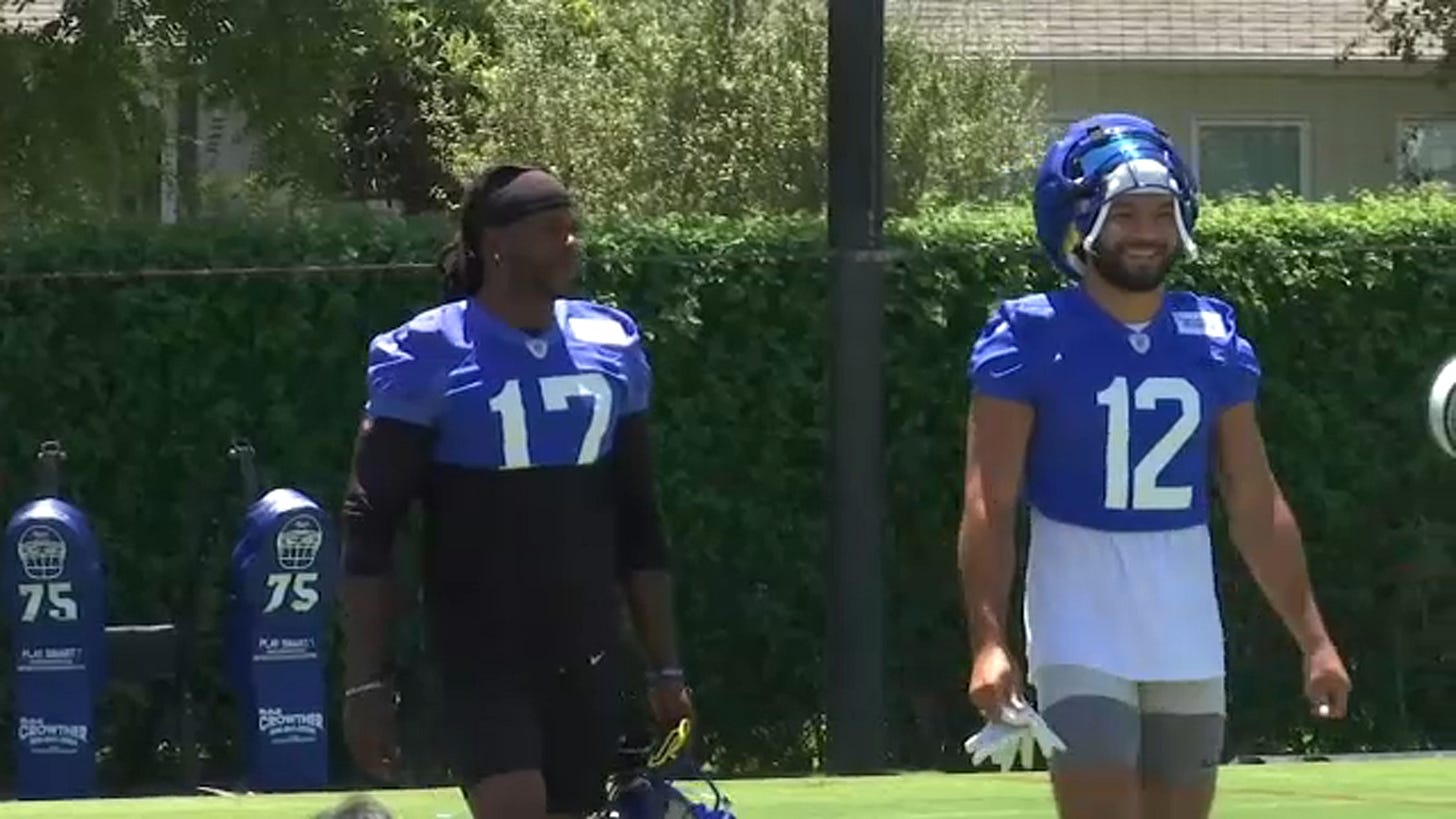
Tuesday and Wednesday, where the story and the non-story were had. Tuesday, July 28, was Day 3 of the first block, a closed to the public light walk through to pace bodies, and Stafford had his scheduled rest day, as well as another yesterday, and the team is off today as I write this post…Read the Full Article on the Los Angeles Rams Substack!
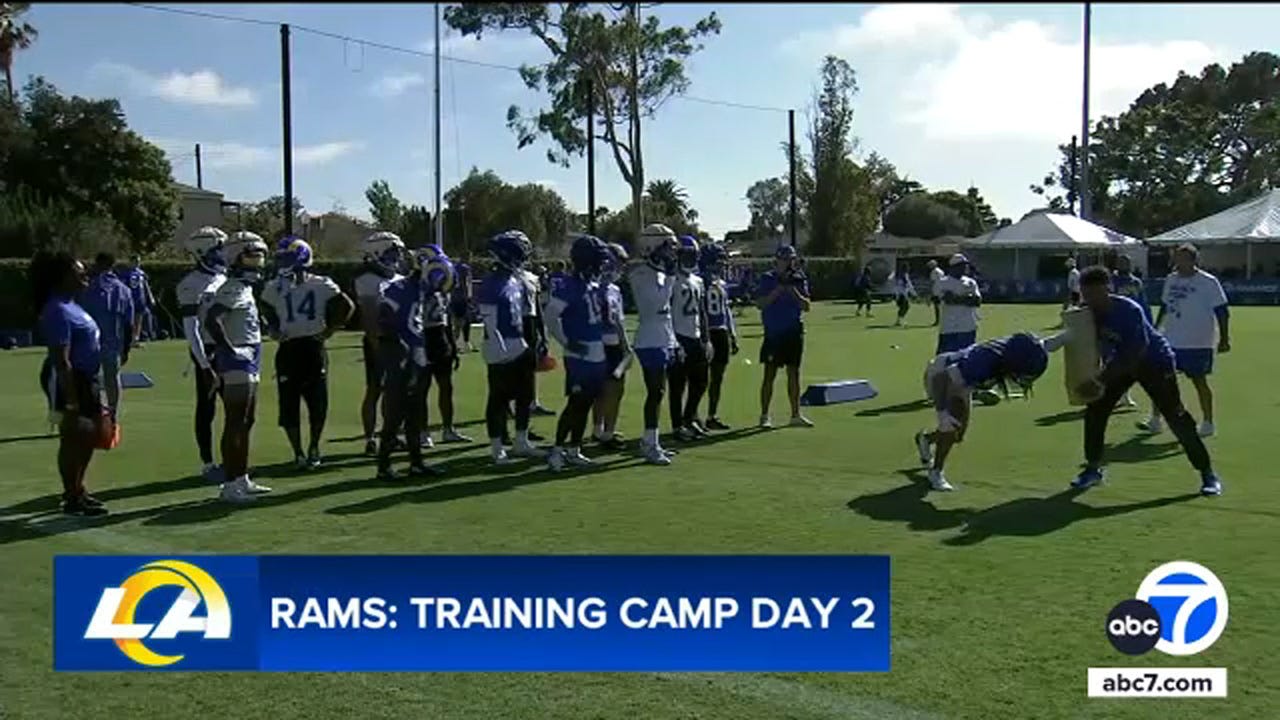
The news that day came actually off the field, as McVay was asked whether he will finally make a decision on Aaron Donald, and he gave pretty much the same answer as he had throughout the camp, that training is going well, but nothing is decided, and no deadline is looming over Donald’s potential exit. I actually don’t have much new to add on the subject myself, beyond the reading of the room, and feeling like this week’s speculation had more weight than usual. For what it’s worth, my own feelings on the Donald situation haven’t changed, as I think the team is best without him, but a fast, disruptive interior presence would be nice, but I want to see these guys play for a few weeks before I start lobbying for change. Read the Full Article on the Los Angeles Rams Substack!
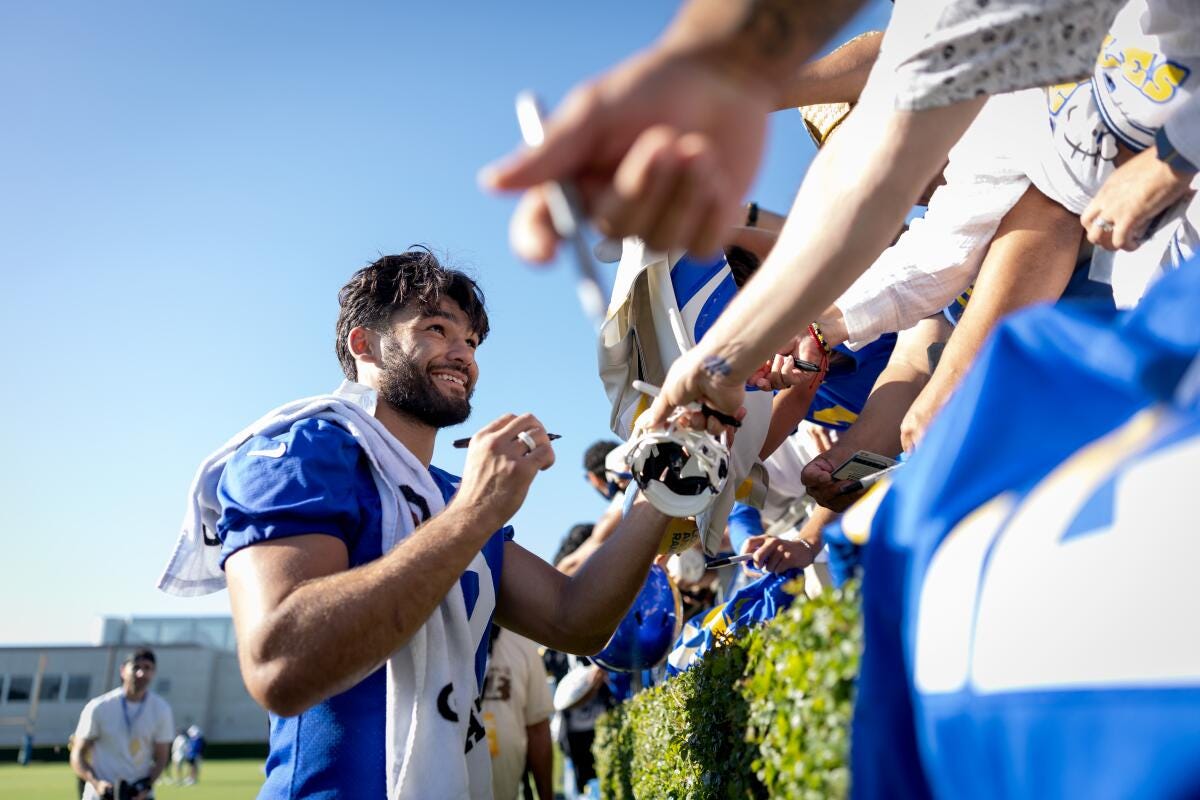
But on Wednesday, the mood shifted completely, as the team opened up their practice to the public and Stafford was back under center, and looked good doing it in his first walk through at first team offense, Puka Nacua did Puka Nacua things, and rookie CJ Daniels continued his meteoric rise up rookie rankings, which seems less like a fluke this week after looking at his combine numbers. I saw his body stats recently, and therefore, I laid off lobbying for a wide receiver from the outside. Set Deebo Samuel aside. Unless Daniels cannot play at the level Diggs can play, let’s wait and see Daniels in action. Read the Full Article on the Los Angeles Rams Substack!
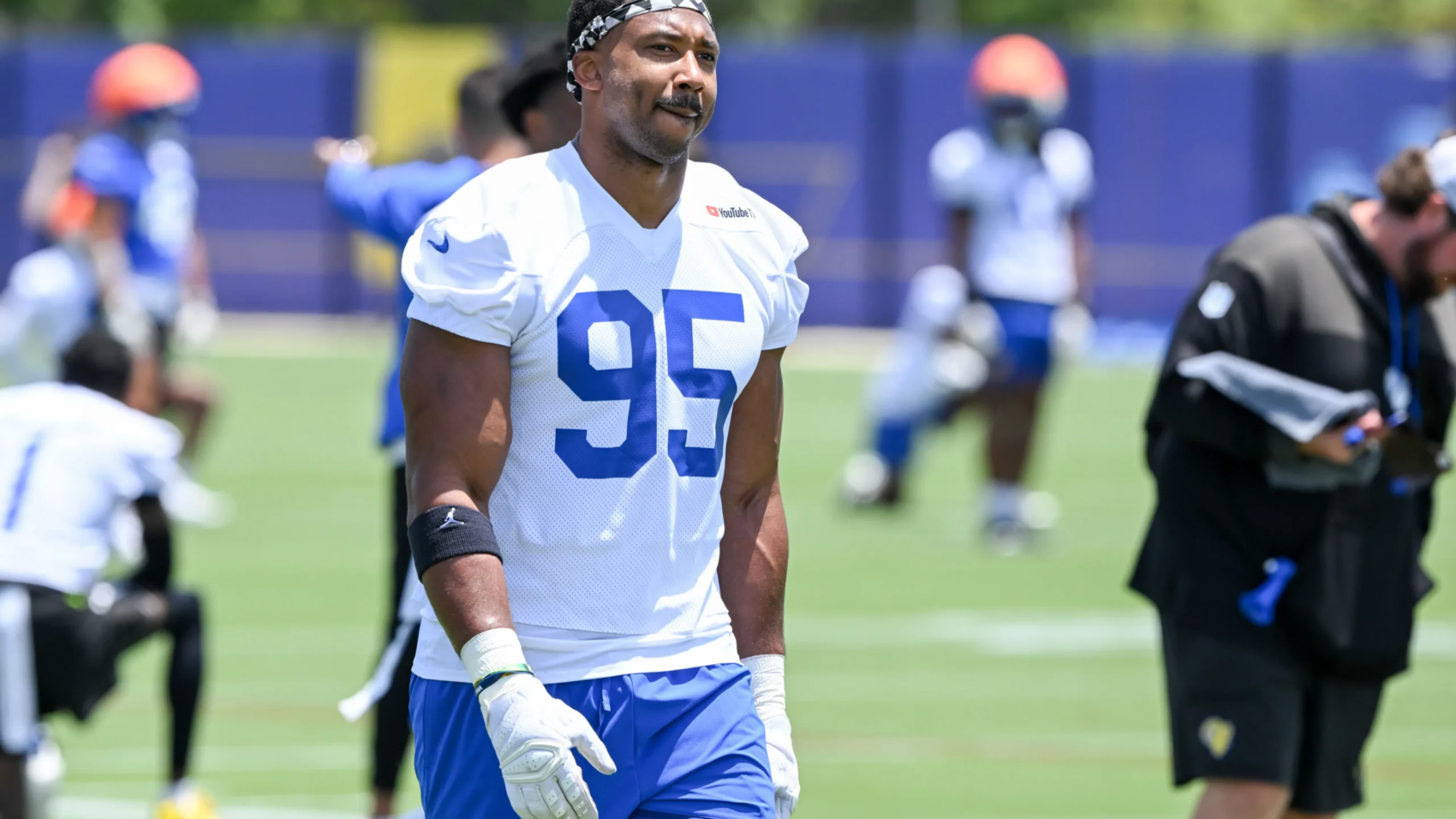
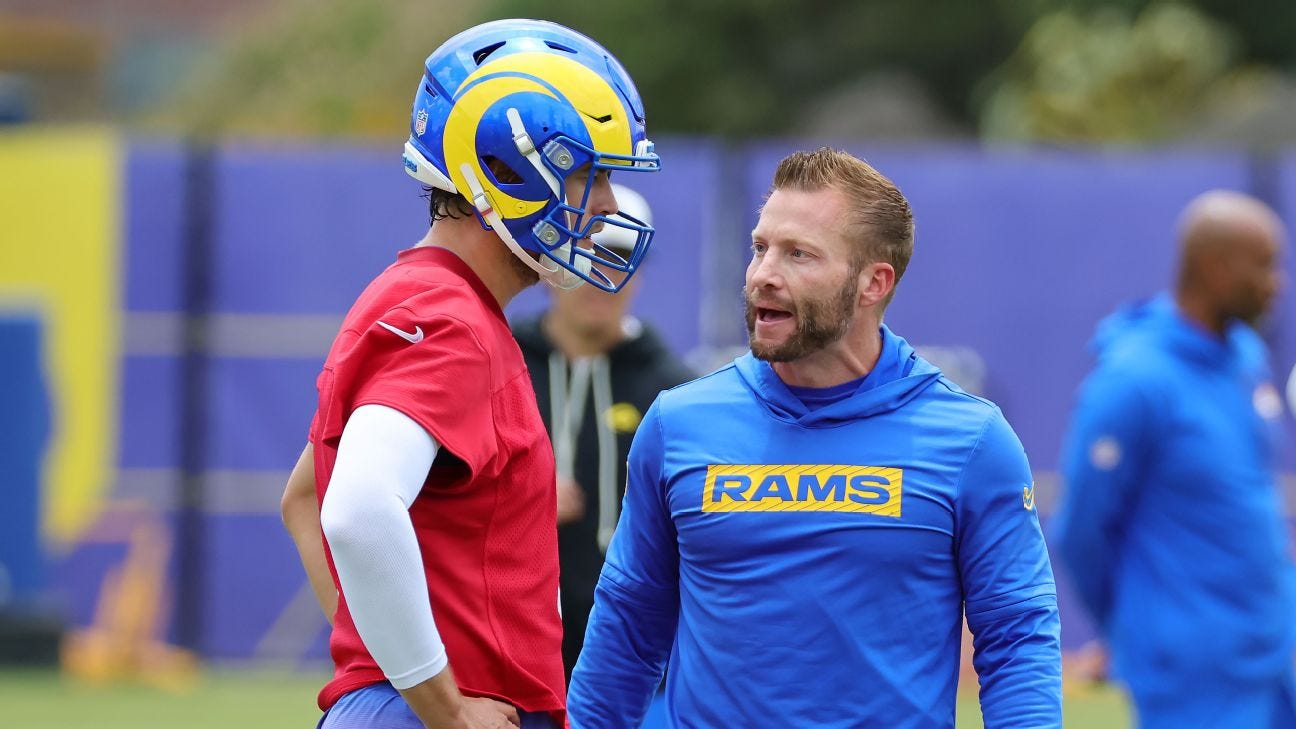
Two days in, and they’ve already had a month’s worth of stories. It was a closed scrimmage on Sunday with no fans allowed in at all, but they opened the doors for the first time this summer on Monday. That first day was a 2:45 PM start with the first practice at 4:15, and the weather was pretty great. Sunny and in the upper 80s, about as good as it gets for an early-August practice, and even without pads the team is putting out storylines by the hour. Read the Full Report on the Los Angelas Rams Substack!
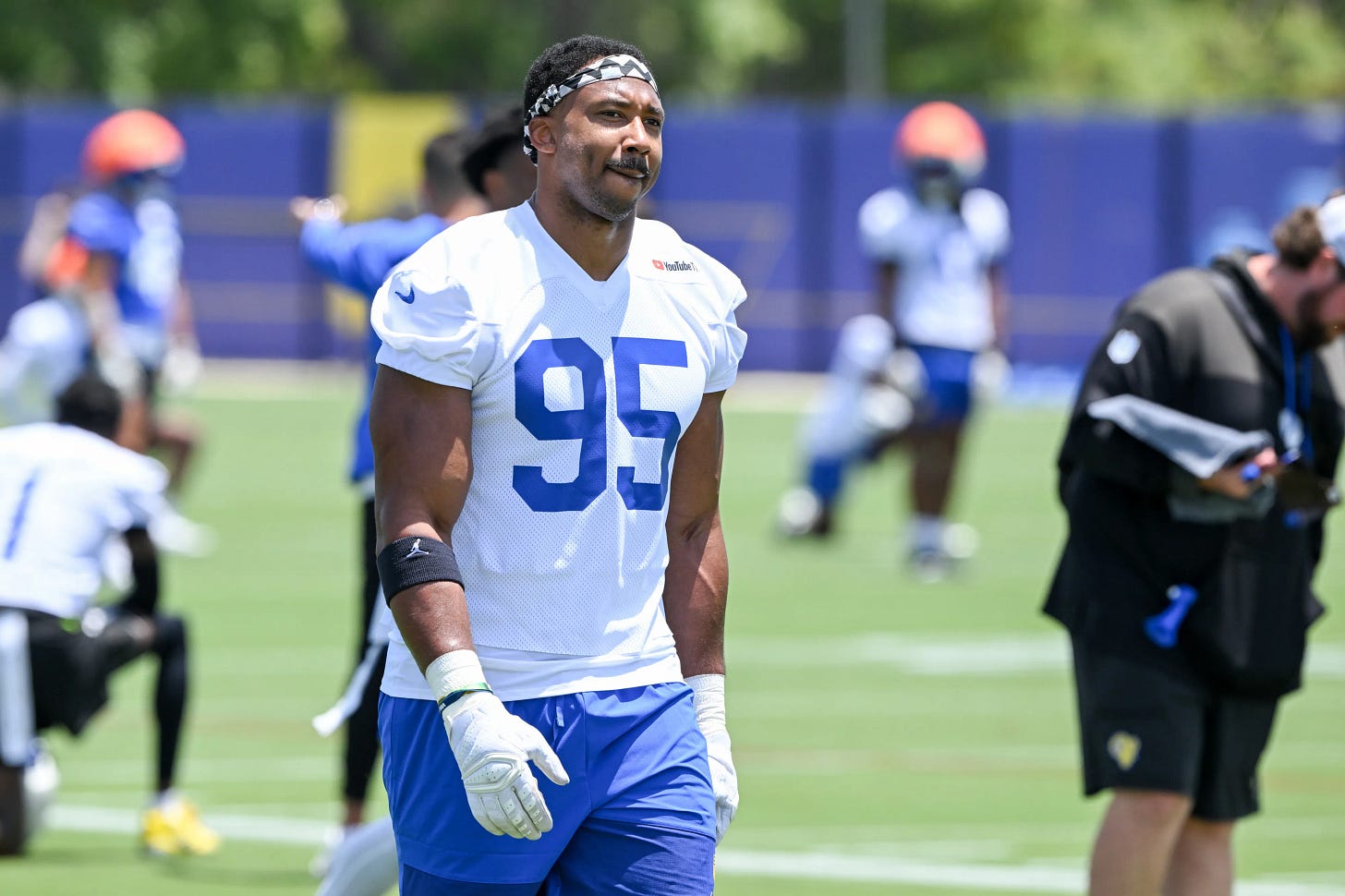
Garrett’s first practice lived up to the hype. They’ve been building to this moment since the trade with Cleveland made it official, and Sunday provided the defense with its first real look at Myles Garrett playing in a Los Angeles uniform. He spent his first few weeks back on the roster working in empty facilities doing individual drills, so it was a true debut of sorts and the staff wasted no time throwing him into 11 on 11 drills against the ones and twos rather than saving it for a walkthrough later in the week. He was every bit the dominant force they’ve claimed he’d be even without the pads, and defensive coordinator Chris Shula made sure to acknowledge just how thrilled he was with the first real look at the franchise. “We’ve been looking forward to it all week,” Shula told reporters of the highly anticipated debut after the session, and Trent McDuffie was almost as giddy next to him while showing off his teammate. “You can sense the aura as soon as he walks in the building,” McDuffie said. Meanwhile, one writer who attended the session had even more to say about the impact of the first time Myles Garrett was on the field wearing a Rams uniform. “It only took one practice for him to make the case that LA will be the team to beat this season,” he wrote about the early look at the new additions on the defensive line.