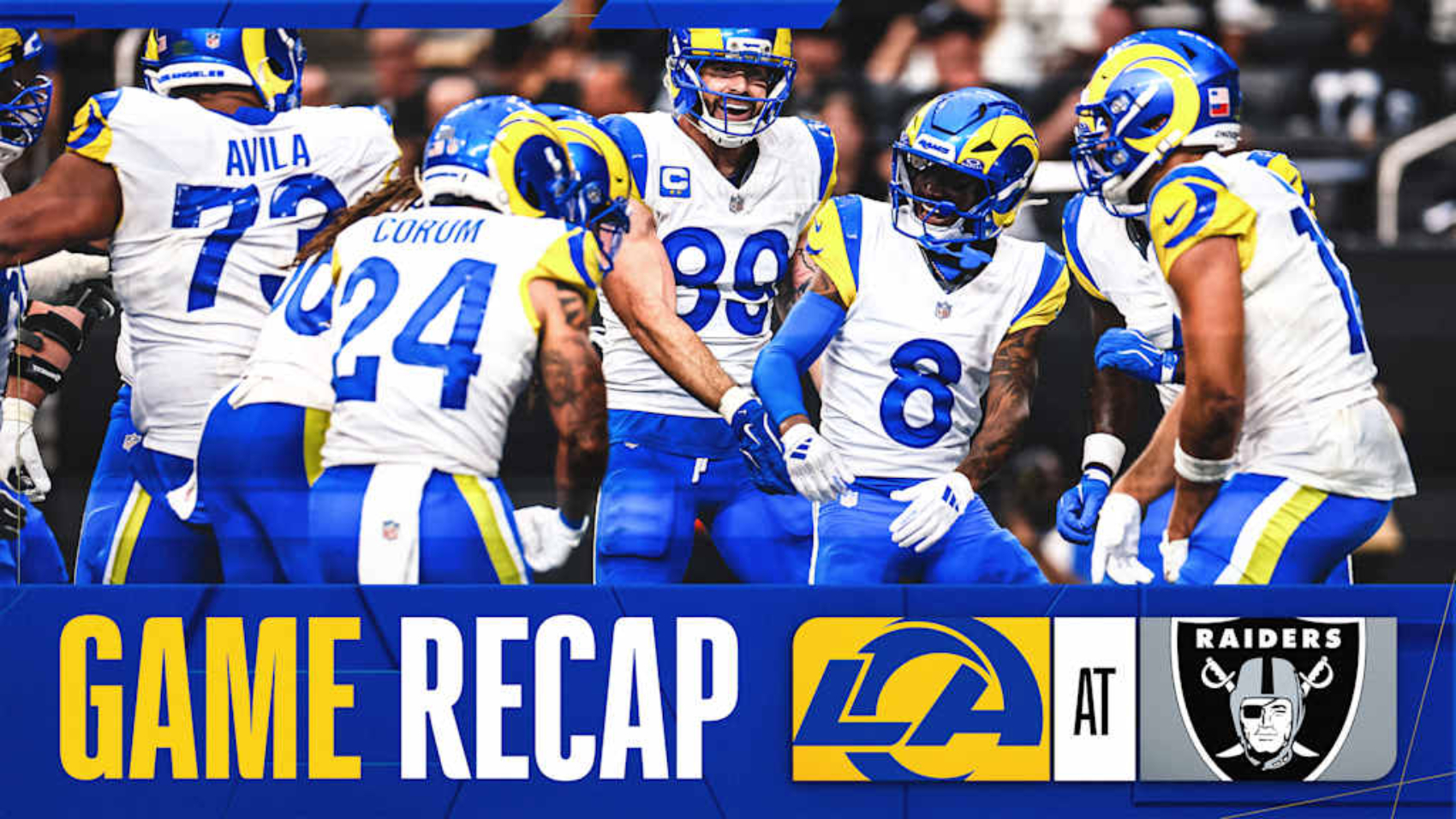
On The Rampage: Ty Simpson in the first round, Max Klare in the second, Keagen Trost in the third, CJ Daniels in the sixth, and Tim Keenan III in the seventh
The 2026 NFL Draft was supposed to be a reinforcement exercise for the Los Angeles Rams, a team that is not rebuilding and not searching for identity. This is a roster anchored by a veteran quarterback, supported by established offensive weapons, and constructed with the expectation of competing in the present. What unfolded over the course of the draft did not reflect that reality. Instead, it produced one of the smallest draft classes of the Sean McVay era, heavily tilted toward offense, and defined by decisions that appear misaligned with the team’s immediate needs.
The class consisted of five players: Ty Simpson in the first round, Max Klare in the second, Keagen Trost in the third, CJ Daniels in the sixth, and Tim Keenan III in the seventh. Four of the five selections were offensive players. It was a class that, from the opening night through the final pick, never fully established a clear or consistent approach. Read the Full Story at the Los Angeles Rams Substack!
On The Rampage: The Rams’ No. 13 Pick Reflects a Misread of Timing, Urgency, and Draft Value
Rams’ Selection of Ty Simpson at No. 13 Raises Questions About Timing and Draft Value
The Los Angeles Rams used the 13th overall pick in the 2026 NFL Draft on Alabama quarterback Ty Simpson, a decision that immediately shifted attention away from the roster’s current trajectory and toward a longer-term projection at the most important position in the game. For a team structured to compete now, the selection stands out not because of the player alone, but because of the context surrounding it.
At the time of the pick, the board still offered players expected to contribute immediately. Rueben Bain Jr. remained available and was selected at No. 14. The Philadelphia Eagles then traded up to secure Mikael Lemon. Both players project as contributors in the near term at positions where performance is measured on every snap. The Rams passed on both. They also passed on Oregon tight end Kenyon Sadiq, who, despite the Rams’ existing depth at the position, was widely regarded as one of the strongest overall prospects still available.
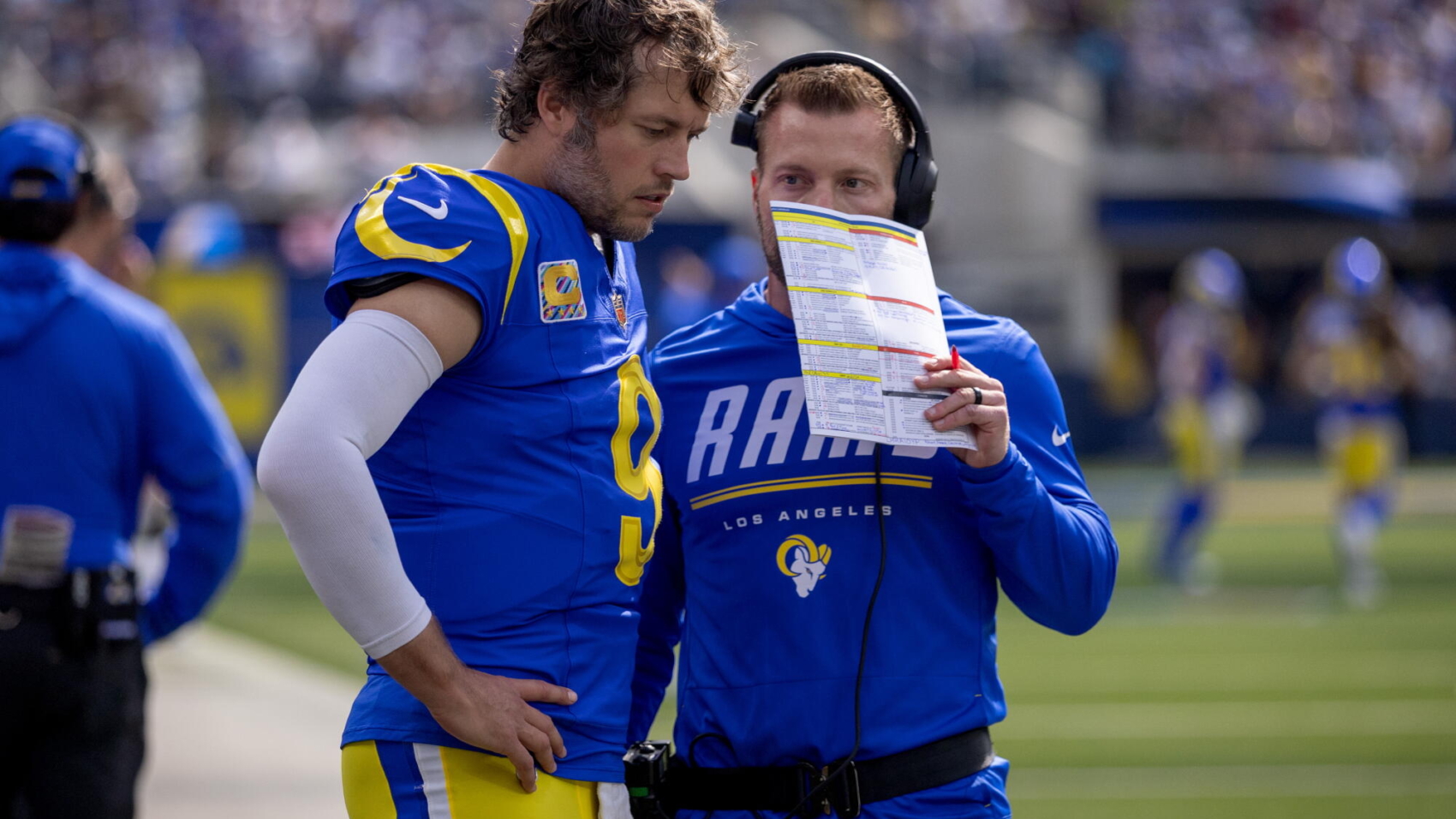
The selection becomes more difficult to reconcile when placed alongside the current quarterback situation. Matthew Stafford remains the starter and continues to perform at a level that supports contention, especially considering he was the MVP last season. His contract runs through the 2026 season, and while there has been periodic discussion about retirement, the organization has maintained a flexible, year-to-year approach rather than signaling an immediate transition.
“We’ve been like that,” head coach Sean McVay said when asked about Stafford’s status. “You’ll probably see us put another year in there as kind of a placeholder, like we’ve done each of the last couple years. But he’s earned the right to be able to be on a year-to-year basis, and that’s something that we’re comfortable with out of respect for him. And hopefully he continues to say, every year, ‘I’m ready to go again.’”
That framework suggests continuity rather than urgency. Stafford is “ready to go again” this season, and beyond 2026 remains open-ended rather than defined.
On The Rampage: The Rams at No. 13 and the Demand for an Immediate Starter Otherwise Trade it Away!
Today is what it must feel like for people when they wake up on Christmas morning. Like any red-blooded American, the lead-up includes putting on Draft Day, the Kevin Costner and Jennifer Garner film, featuring Terry Crews, Chadwick Boseman, Ellen Burstyn, Frank Langella, Denis Leary, Sam Elliott, Timothy Simons & Kevin Dunn from Veep, Chi McBride from Hawaii Five-0, Patrick St. Esprit, Wade Williams, and Pat Healy whom have all been a ton of things but anyway, the Rams enter the 2026 NFL Draft in Pittsburgh with seven selections. The focus is entirely on No. 13 overall, a pick acquired from Atlanta that gives the organization access to a tier of prospects it rarely reaches.
The remaining picks, 61, 93, 207, 232, 251, and 252, provide flexibility, but none carry the same expectation of immediate impact. That expectation rests on the first-round decision, and the standard is straightforward. The player selected at 13 must be capable of starting immediately. If that threshold is not met, the pick itself becomes the asset, and moving it is the more rational approach.
On The Rampage With One Week Remaining Before The 2026 NFL Draft
With one week remaining before the 2026 NFL Draft, the Los Angeles Rams are operating in a space that feels anything but straightforward. The public conversation has settled into a predictable rhythm, but the underlying signals coming out of the organization suggest something far more calculated is taking place. I almost do not want to say anything in case I alert the wrong people. There is a growing sense that what is being discussed externally does not fully align with what the Rams are actually preparing to do, and that disconnect is where this draft begins to take on real significance, if my theory is indeed true.
At the center of the conversation is the No. 13 overall pick, a position that has quickly become one of the most scrutinized slots in the first round. The prevailing narrative continues to push the idea that the Rams will target a wide receiver, with USC’s Makai Lemon emerging as the most frequently projected selection. The reasoning appears simple on the surface. The offense could benefit from a reliable third option to complement Puka Nacua and Davante Adams, adding depth and flexibility to an already dynamic passing attack. Analysts across multiple outlets have reinforced this idea, creating a sense of consensus that feels almost too clean. I have identified more concise needs for the team.
The problem is that it does not fully match how the Rams typically operate when the stakes are this high.
This is an organization that has consistently prioritized impact over convenience. When they invest premium draft capital, they are not looking to fill a secondary role. They are looking to alter the structure of the roster in a meaningful way. A wide receiver, particularly one projected as a third option, does not clearly meet that threshold. That disconnect is what makes the current wave of mock drafts feel more like misdirection than insight.
There is the trade capital reality, which continues to shape every possible scenario. The Rams hold that No. 13 pick, acquired through prior maneuvering, but no longer possess their original late first-round selection. That lack of additional first-round flexibility increases the pressure on this pick and raises the likelihood that it could be used as part of a larger move. This is not a team positioned to sit still and follow the board. This is a team that has repeatedly shown a willingness to reshape the board entirely.
That is where the Myles Garrett situation becomes impossible to ignore.
What initially sounded like speculative chatter has quickly evolved into something far more credible, driven by specific developments in Cleveland. The adjustment of Garrett’s contract structure, particularly the timing of his option bonuses, has created a window that allows the Browns to consider a trade without immediately absorbing the full financial impact. This is not a minor detail. It fundamentally changes the conversation around his availability.
The Rams have already positioned themselves as a team willing to operate aggressively in these situations. Reports indicating their support for expanded rules on trading future draft picks only reinforce that mindset. When you connect those elements, the idea of pursuing Garrett becomes consistent with how this organization has historically approached roster construction. When they identify a player who can change their ceiling, they act decisively. This would obviously be the best scenario and, of course, a lot of wishful thinking on my part.
The rumored framework for a deal, built around the No. 13 pick, a future first-round selection, and a young pass rusher such as Byron Young, reflects the kind of package that aligns with both teams’ potential motivations. However, that is seemingly a lot to give up, and I believe Byron Young is around for the long run. I would give up draft picks with ease, but a player of that caliber has to be off-limits for now. Taking him out of the equation, for the Rams it represents an opportunity to add one of the most dominant defensive players in the league during a window in which they are still fully committed to competing at a high level. For Cleveland, it provides future capital that could be critical if they are positioning themselves to target a quarterback in a later draft cycle.
When you shift focus away from the noise, a different set of priorities begins to emerge. The offensive line remains one of the most important areas of long-term stability for this team, particularly with Matthew Stafford still operating as the centerpiece of the offense. Miami’s Francis Mauigoa continues to surface as a logical fit, not because he fills a temporary need, but because he provides structural protection that extends the viability of the entire system. I like that pick far more than the wide receiver option, but I am open to being wrong. Investing in that position would align directly with the Rams’ history of making decisions that support their quarterback above all else, so from my perspective, it is a win picking an Offensive Lineman.
Defensively, the connection to Ohio State linebacker Sonny Styles has gained real traction. I like that one too. Styles represents the kind of player the Rams have consistently targeted when reshaping their defense. He is versatile, instinctive, and capable of impacting multiple levels of the field. Within Chris Shula’s evolving scheme, a player like Styles is not simply an addition. He becomes a foundational piece that influences how the entire unit operates. The growing buzz around a potential move into the top ten to secure him reflects a level of interest that goes beyond casual evaluation.
At the same time, the Rams are not limiting themselves to a single path. There is continued discussion around the possibility of targeting Anthony Richardson as a long-term successor to Stafford. This is not about an immediate transition. It is about controlled development. The idea of integrating Richardson into specific packages while allowing him to grow within the system reflects a forward-looking approach that balances present competitiveness with future planning. I do not think that we need to focus so much on Quaterback right now.
There are also smaller but meaningful developments shaping the draft board, and none are more polarizing right now than what has happened with Miami edge rusher Rueben Bain Jr. The reported decision by some teams to remove him from their boards following a serious off-field incident has significantly narrowed the field of top-tier defensive options. That matters, especially for a team like the Rams that is operating with limited premium draft capital and needs to maximize impact with every decision. Before all of this surfaced, I had Bain projected as one of the top defensive players available, and that evaluation was based purely on what he brings on the field. I wrote about him in previous On The Rampages.
What is difficult to reconcile is how quickly perception has shifted. The incident in question stems from a tragic car accident in 2024 that resulted in the death of a passenger months later. By all available accounts, this was not tied to alcohol, and the victim’s family itself described it as an accident. That context should matter when teams are making long-term evaluations about a player’s future. Instead, what seems to be happening is a complete reclassification of his draft value based on optics and how he handled interviews, rather than strictly on football ability. There are also concerns being raised about past driving behavior and whether he showed enough accountability during the pre-draft process, which has only added to the hesitation from teams.
At the same time, there are additional factors being layered into the evaluation that feel secondary compared to his production. Questions about arm length and the decision not to participate in full testing at his Pro Day have been used to further justify the drop. In a vacuum, those are normal scouting considerations, but in this case they seem to be amplifying an already negative narrative rather than defining it. For a player who was once viewed as a potential top-three talent, the shift has been dramatic.
From a Rams perspective, this is where the situation becomes especially frustrating if his driving ability is being weighed more heavily than his actual performance on the football field. If Bain is still available within range, the question should be whether the talent outweighs the perceived risk. Simply put, manage the off-field concerns by limiting any potential issues. Provide transportation solutions, whether that means rideshare services or a team-managed plan, and remove the risk entirely. I would take this player over trading for Myles Garrett, depending on the cost. This is also an organization that has managed personalities and past situations before, and it is fair to question whether this particular case is being evaluated consistently compared to others across the league. If the football evaluation still places him among the best defenders in the class, removing him entirely from consideration feels excessive.
Every adjustment at this stage carries weight, and this one could have real consequences. If the Rams pass on a player of this caliber based on a situation that, while serious, does not directly impact his ability to perform on the field today, they risk missing out on one of the most impactful defenders in the draft. At a certain point, teams have to decide whether they are building a roster based on projection and performance or reacting to narratives that may not fully reflect the player’s future.
Even the uncertainty surrounding what has become the elephant in the room, Puka Nacua’s availability for offseason activities, adds another layer to the equation. Beyond him acting like a kid on the field, which I am also sensing off the field, the question becomes what exactly is going on. What is he in rehab for? Coke? Alcohol? Anger? Just being a dumbass? I have only heard that he is socially inappropriate at times, which raises the question of why, I suppose. Does he grab women by the pussy now that he is a star? The POTUS says that is allowed, so maybe he thought it was OK, but in seriousness, is he going to some kind of behavioral school or rehab? And if he is in rehab, what is his drug or alcohol of choice? Can you send someone to rehab for acting stupid in social situations?
I truly hope that is all it is, but considering the magnitude of this, I highly doubt it is just about a childish personality. That kind of behavior is usually driven by something deeper and potentially addictive. I suppose something could make someone act out like that. I have said this every day since I started watching him, that he acts like a total kid. I have said that for two years, both in writing and out loud. He is a kid on that field. Watch how he acts in between and after plays and when he is on the side line. It is like watching a kid on a school field.
While the situation remains unresolved and all over the place in my head, any disruption to the offensive structure increases the perceived need for additional receiving depth. This is where the wide receiver narrative continues to find traction, but it still does not fully align with the organization’s established approach to high-value decision-making. Are these really the saviors if needed?
Overall, I think Puka will be fine. If he is on any kind of bad drug, he needs to stop, and if alcohol makes him act out, it needs to be under control. This is your job. These players are some of the luckiest people in the history of the world. While they get paid millions of dollars, they need to handle it. They need to play and not grab women by the pussy, so to speak. You will get laid. I am sure Puka sees how it is now. Just act like a real man and stop acting stupid. Have fun like a kid, but do not annoy people like a kid. He will break out of this ASAP.
Beyond the roster, the Rams are also engaging their fan base through the opening of their Draft House in Inglewood on April 16. This initiative provides a controlled window into the draft process, offering fans a closer look at the environment while maintaining the strategic discipline that defines the organization’s internal operations. It is a reminder that even in moments of transparency, the Rams remain highly intentional about what they reveal and what they hold back.
With all of these elements in play, the central question becomes less about which position the Rams will target and more about how aggressive they are willing to be. The wide receiver projections may continue to dominate public discussion, but they feel increasingly disconnected from the broader context. Defensive players seem to be what is being actively discussed between the Rams and other teams. The more plausible outcomes involve structural impact, whether through a foundational draft selection, a targeted move up the board, or a significant trade that reshapes the roster immediately.
Think of it this way, we had one of the best offenses in the entire league last season. We could score at the drop of a dime, whenever it was needed. For a stretch of about eight games, this team was unstoppable. They rolled through opponents, and even in the losses, most of those games were tight, with the exception of one. In my view, they could have won, or should have won, nearly all of them.
Actually, take it a step further. They should have won every one of those games. Instead, they lost several that were completely winnable. The point is, this was an offense that could drive the length of the field and score with seconds left, even backed up deep in their own territory. That is how efficient and dangerous they were.
So this sudden emphasis on adding more offensive pieces, especially at wide receiver, does not make much sense to me. This was already one of the most productive units in football. The wide receivers were putting up the most touchdowns in the division, the quarterback won MVP, and the system clearly worked at a high level. Shifting focus back to offense feels unnecessary and, frankly, a bit misguided given where this team actually needs to improve.
The timeline is what drives all of it. I get it. We all get that Matthew Stafford’s window is finite, and every decision is being made with that reality in mind. The Rams are not operating with a long rebuild horizon. I get that about us. They are operating with urgency, with a clear understanding that the moves they make now will define the final phase of this era while setting the stage for what comes next.
That said, Stafford still has up to three more years, and if he does what Tom Brady did and wins a couple of Super Bowls, he could extend that even further and play another year or however long he wants. I think people need to stop talking about him like he is about to retire. He is not leaving anytime soon. Three years feels like the realistic window, and that should be the baseline. If they do not win Super Bowls in the next two years, then we can start talking about the end of his career, but for now, let it play out and go from there. It is one less thing for everyone to worry about. Stafford is here, and he is playing for at least the next few years. He has earned that, so that conversation needs to stop and move on to something else.
That is why the current sense of misdirection feels deliberate. It is not confusion. It is control. The Rams are managing the narrative while positioning themselves to act when the moment is right. And when that moment arrives, whether it comes through the No. 13 pick or a move that no one fully sees coming, it is likely to clarify their direction in a way that the current speculation cannot.
One week out, the noise is loud, but the intent is quiet and precise. That is exactly where the Rams want to be. I just wish I had more information, but that is me being an anxious Rams aficionado.
With 22 days remaining before the 2026 NFL Draft, the Los Angeles Rams have moved past speculation and into a more defined draft plan, with the focus now on how they are going to execute it. Internally, the priorities are clear which is to add meaningful roster depth, address the lack of mid-round draft capital, and position the team to maximize what is widely viewed as one of the final competitive windows with Matthew Stafford. The Rams’ current draft structure includes Pick No. 13 in the first round, Pick No. 61 in the second, Pick No. 95 in the third, and then no selection until Pick No. 207 in the sixth, which is why trade-down discussions have centered on adding picks between the third and sixth rounds.
The most immediate shift is at quarterback behind Stafford. The idea of adding Kirk Cousins is no longer part of the equation, and that matters more than it initially appeared. First, second, and third, they did not need him for five years. If I had known the nature of that deal and the direction he wanted, I would never have mentioned him. Regardless, to me, that path would have represented a short-term insurance policy with proven stability. Its removal forces a recalibration.
The Rams are now operating on two parallel tracks: revisiting the possibility of a reunion with Jimmy Garoppolo while simultaneously accelerating evaluations of developmental quarterbacks in the late second- to early third-round range.
Internally, there is little appetite to enter a season of this magnitude without a credible QB2, particularly given what is understood to be the next few years as Stafford’s final run at this level.
That urgency is not isolated to one position. It is embedded in the structure of the entire roster and, more importantly, in the structure of the draft capital itself. General Manager Les Snead has been explicit about the issue. The gap between Pick 95 in the third round and Pick 207 in the sixth is not just inconvenient, it is strategically untenable. For a team attempting to sustain a deep playoff push, that absence of mid-round selections removes the ability to build depth, hedge against injury, and inject cost-controlled contributors into key rotational roles. This is a real issue for the Rams, and it’s something they are trying to address, most likely by adding more mid-round picks.
Head Coach Sean McVay has acknowledged that trading down is now an option. The Rams currently hold Pick No. 13 and, as it stands, have no selections between Pick 95 and Pick 207, which creates a significant gap in the middle of their draft board. Because of that structure, any move back would be aimed specifically at adding picks within that range to improve roster depth and give the team more flexibility across multiple positions. The Rams have been linked to multiple draft scenarios involving Pick No. 13, including trading down to acquire additional mid-round selections, as well as the possibility of moving up if there is a specific player they believe will not be available at their current spot.
One scenario that has been discussed involves a move with Detroit, sliding from No. 13 to No. 17. In that situation, the Rams would remain in position to select from the same group of players they are already evaluating, while also adding future draft capital, including a 2027 third-round pick along with additional mid-round value. Other potential trade-down scenarios into the late teens or early 20s, with teams such as Minnesota, Carolina, or Philadelphia, would serve a similar purpose by directly addressing the gap between Pick 95 and Pick 207. These types of moves would allow the Rams to add multiple selections within that range, giving them more opportunities to fill out the roster rather than relying on a limited number of picks.
At the same time, the Rams are not operating without contingency. There remains a credible scenario in which they could move up, specifically into the No. 10 range, if they believe a priority target is at risk of being taken by a team like Miami at No. 11. That target has been widely linked to USC wide receiver Makai Lemon, who fits the profile of the type of dynamic offensive weapon Sean McVay values. However, this is where the evaluation becomes more important. The Rams do not appear to believe they need to force that selection at No. 13, and based on the way the board is shaping up, neither do I.
That belief changes everything.
The coaching staff has made it clear that wide receiver depth can be addressed later in the draft. This is not a dismissal of the position, it is a recalibration of value. With Davante Adams and Puka Nacua already defining the top of the depth chart, the requirement is not for a headline addition. It is for a complementary presence: a precise route runner, a vertical separator, or a developmental speed threat who can stretch coverage and create space within McVay’s system. Players with those profiles names like KC Concepcion or Ian Strong, are expected to be available on Day 2 or early Day 3. That reality is driving the willingness to move off No. 13.
However, reducing the Rams’ needs to wide receiver alone would miss the broader picture. This is a roster that has been aggressively reshaped, most notably through the acquisition of Trent McDuffie, a move that cost significant draft capital but immediately elevated the secondary. The follow-up additions with Jaylen Watson and the extension of Kamren Curl, have reinforced that unit, but they have also shifted the team’s remaining priorities.
Cornerback depth is still a concern, particularly in the slot and along the boundary, where recent departures have created openings that must be addressed. The Rams are not looking for another star; they are looking for players who can function within the system, handle assignment discipline, and contribute immediately in sub-packages.
Along the offensive line, the need is more acute. The Rams require a true swing tackle or omeone capable of stepping in on either side without compromising the integrity of the offense. Behind the current starters, the depth chart lacks proven reliability, and given the physical demands of a full season, this is a position that cannot be ignored. It is a priority that aligns perfectly with a trade-down strategy, where additional mid-round picks can be deployed to secure depth without sacrificing value elsewhere.
At linebacker and along the edge, the situation remains fluid and closely tied to free agency. The Rams have positioned themselves to make one more calculated move before the draft, targeting players who can provide immediate impact without long-term financial strain. Names such as Germaine Pratt and Leo Chenal have been monitored for their range and fit alongside Nate Landman, while the possibility of adding a veteran pass rusher like Trey Hendrickson remains under consideration if the financials align. remember please, this is about completing the roster with precision.
The financial flexibility to pursue these options was created through Stafford’s recent contract restructure, a move that reduced his 2026 cap hit and opened the door for both the McDuffie acquisition and an additional late-stage signing. That restructuring was strategic, designed to give the Rams one more opportunity to push their roster into true contention.
All of these decisions converge at one critical point: Pick No. 61.
This selection, early in the second round, is the fulcrum of the Rams’ draft strategy. It is where the board begins to thin, but where starting-caliber talent remains available. It is also where the Rams can address multiple needs without the pressure of the first round. If the team successfully trades down from No. 13 and acquires additional picks, No. 61 becomes part of a cluster, a sequence of selections that can be used to systematically fill gaps across the roster. If they remain at their current positions, it becomes a targeted decision.
Now, when you consider everything that has been done to date, quarterback is firmly in play here. Prospects such as Garrett Nussmeier, Drew Allar, Ty Simpson, and Carson Beck represent developmental options who can be brought along behind Stafford, providing both insurance and a potential bridge to the future. Offensive tackle is equally viable, particularly if a player with starting traits begins to slide into this range. Wide receiver, while less urgent at this point, remains a possibility if the value aligns with the Rams’ evaluation.
What is clear is that Pick 61 is a foundational asset.
Stepping back, the broader context is clear. The Rams are coming off an NFC Championship appearance that ended in a 31–27 loss to the Seattle Seahawks on January 25, 2026. That result confirmed that the current roster is competitive at the top of the conference, but it also showed where depth and roster balance still need to be addressed.
The offseason program begins April 20 with voluntary workouts, followed by OTAs from May 26 through June 11 and mandatory minicamp on June 15–16. Those dates will provide the first on-field look at how the roster is coming together, but the key decisions that shape that roster are being made now, particularly with the draft approaching.
The current structure of the team includes established players at key positions, along with recent additions in the secondary, but the draft remains the primary opportunity to address depth across the roster. With Pick No. 13, Pick No. 61, and Pick No. 95, followed by no selection until Pick No. 207, the focus is on how to use those picks, or potentially move them, to fill out multiple areas rather than relying on a single addition.
The approach to this draft is tied directly to that structure. Adding more selections between Pick 95 and Pick 207 would give the Rams additional opportunities to address multiple positions, while remaining at No. 13 would limit those opportunities to a smaller number of players. These are the decisions in front of the team over the next three weeks.
This is not about redefining the roster, but about building around what is already in place and addressing the areas that remain open. The draft provides the clearest path to doing that, whether through adding players at current positions of need or adjusting draft position to increase the number of selections available. Over the next 22 days, those decisions will determine how the Rams complete the roster heading into the 2026 season.
As we head into the final stretch before the draft, the next week becomes especially important in terms of how much, if anything, we actually learn about the Rams’ direction. One consistent takeaway, reinforced by reporting from the writers at Rams Wire, is just how little the organization reveals during this process. The Los Angeles Rams do not operate like most teams when it comes to pre-draft evaluation. They rarely conduct traditional top-30 visits, and it is not typical to see Les Snead or Sean McVay publicly tied to combine meetings with prospects. In many cases, they do not attend the combine in the same way most teams do, further limiting the amount of publicly available information.
Instead, their approach is far more controlled. The Rams will attend select pro days and occasionally conduct private workouts, but even those instances are limited in visibility and often go unreported. This is by design. The organization has built a reputation for keeping its evaluation process tightly managed, avoiding unnecessary exposure that could signal interest in specific players.
Because of that, tracking their draft intentions requires a different approach. Any confirmed meetings, whether at the combine, pro days, or private workouts, carry more weight, simply because so little information is made public. Over the next week, attention will remain on those limited data points, as they offer one of the only windows into how the Rams may be shaping their board ahead of the draft.
This is who the team met with so far:
Quarterbacks
QB Garrett Nussmeier, LSU (private workout): Nussmeier confirmed the Rams will fly out to meet with him before the draft.
On The Rampage: I Am Never Wrong About the Rams When It Comes to the Team Itself
I am anxious to talk about the Rams right now, and it is not coming from hype or reacting to what is being said publicly. It is coming from the fact that when you actually sit down and look at this team, not through mock drafts or recycled takes, but through the depth chart, the usage of players, and the direct words coming from Sean McVay, the picture is very different from what is being pushed. I have no interest in repeating what others are saying. I want to analyze this team for what it actually is, because what I see is not lining up with what is being projected, especially when it comes to the draft.
The current conversation around the team includes familiar elements, a circulating rumor being revisited, a wave of draft projections, and the usual layering of outside interpretation. But when you strip all of that away and focus on the Rams themselves, specifically their depth chart, their recent personnel usage, and what McVay is actually saying, the evaluation becomes much more direct. I am going to dissect all of it.
The most immediate issue is not the draft. It is the quarterback room behind Matthew Stafford, and the possibility that the Rams bring in Kirk Cousins is not being treated seriously enough for what it actually represents. The way McVay has addressed it does not sound like speculation. It sounds like intent, or at the very least, a very real option that is being considered.
“I think Jimmy’s working through his process right now. Would love to be able to have him,” McVay said on ProFootballTalk. “There’s some other guys that are out there, but we do need to be able to add another guy into that room, and that’s something that we’re looking at. Obviously, people make some of the connections with Kirk, and if it doesn’t work out with Jimmy, that’s definitely something that – Kirk is as influential as anybody in helping me get to LA in the first place. I know he’s got some other options and some other suitors, but Jimmy and Kirk are guys that I would love to be able to have back with us.”
That is not a throwaway comment. That is a coach identifying two very specific paths. At the NFL Annual Meeting, he made it even clearer.
“And I don’t have a perfect answer for you. We think about it. What does that look like?” McVay said. “Hey, I’d love to have Jimmy Garoppolo back with us. That’s a big deal for us. He’s earned the right to be able to take his time and do whatever he wants. Is there an opportunity to explore, if it’s not Jimmy, (like) Kirk Cousins? Of course. I’d love to be able to be able to see what that looks like. So those are two guys we’ve talked about.”
“I genuinely don’t know that,” McVay said. “I don’t know that. I would say, at this point, when there hasn’t been a decision, it feels less likely than likely, but I don’t want to rule that out.”
“Those are things that we’re very interested in possibly exploring, but again, it’s really premature,” McVay said. “I know Kirk has some other options and opportunities as well, but he’s a guy that I have familiarity with, history and a lot of reverence for because of the gratitude from our experiences together.”
“But we also have to be prepared that if this is the last year, what does that look like as well?” McVay said.
That is the full context, and it matters because this is not just about who backs up Stafford. It is about what happens if the season does not go according to plan at the most important position on the field. In that scenario, there is a clear difference between what Kirk Cousins provides and what Jimmy Garoppolo currently represents. Cousins has the ability to operate a high-level offense within structure, and more importantly, he can run the same system in the same way. The timing, the reads, the mechanics, everything lines up with how Stafford plays the position. That is not a small detail. That is the difference between maintaining an offense and having to adjust it midseason.
I want to make a more subtle point here, though, because when you are backing up a quarterback like Matthew Stafford, who typically stays healthy, you are not playing. That is the reality of the role. I have this opinion in my head that Garoppolo just takes it easy and hangs loose, when that is not a thing when you never play a down every year. It can come across as lazy, even though it is not really laziness. We Ram fans rarely see the backup on the field, and the expectation is that Stafford will continue to be available, which makes evaluating that position more complicated.
Ironically, I like Stetson Bennett in that role, but the coaching staff does not appear to view it that way and is clearly leaning toward either bringing back Jimmy Garoppolo as the No. 2 or adding someone else. There is an argument to draft a quarterback for that spot, but I question whether there is a true successor in this draft, which I have said for weeks. And if you cannot get a true Number 2 and/or a successor, it is not worth picking a quarterback at Number 13. We would need someone to deliver at a high level right away. No offense to anyone, but if the choice is between Jimmy and Kirk Cousins, I would take Cousins for the next couple of years. At that point, the team is likely going to need two quarterbacks anyway, even if Stetson develops.
Garoppolo is not a bad quarterback at all, but at this point, it is fair to question where he is in terms of urgency and performance. I have to presume that he wants to start or at least have a chance to start this year.
That brings the focus to the roster itself, which is where the real evaluation begins. This is where I separate completely from the way people are talking about the draft, because I am not evaluating college players first. I am evaluating what the Rams already have, and what they actually need.
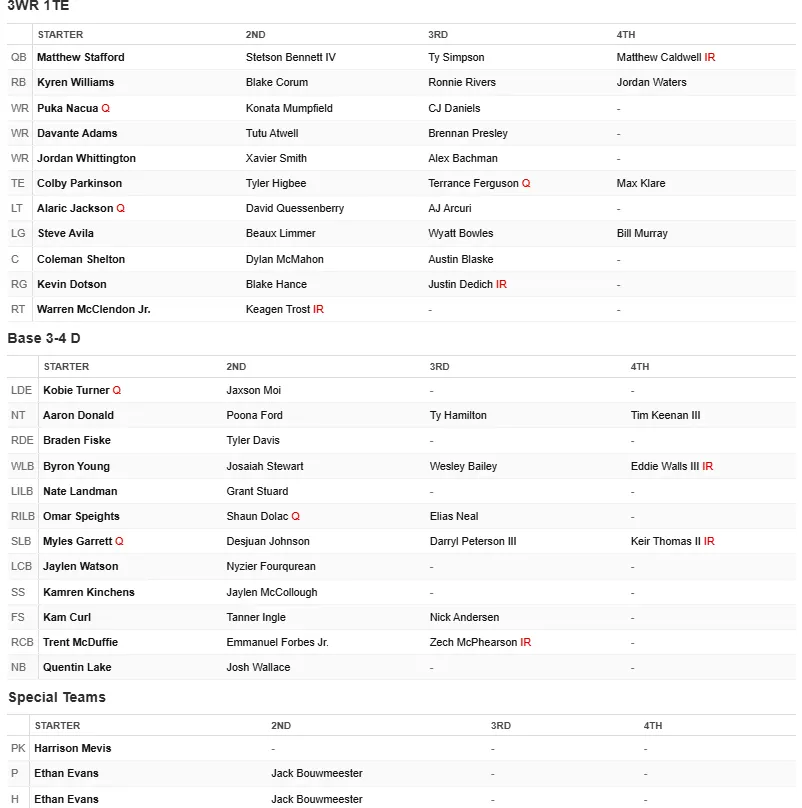
Starting with special teams, this is not a dominant unit, but it is not a weakness either. It is functional, and it can be effective if it performs consistently. Harrison Mevis handles the kicking duties, Ethan Evans is both the punter and holder, and Joe Cardona steps in as long snapper. The return game is clearly defined with Xavier Smith as the primary option and Jordan Whittington right behind him, with additional depth from Ronnie Rivers and Blake Corum. That is already structured. It is not something that needs to be rebuilt. It is something that needs to execute. There is also the factor of development, with second-year players like Konata Mumpfield potentially taking a step forward, which matters more than people want to acknowledge. These are the areas where diamonds in the rough are born.
Offensively, beyond quarterback, the structure is already in place. Kyren Williams leads the running back group, with Blake Corum, Ronnie Rivers, and Jarquez Hunter providing depth. That is a stable position group. At tight end, the Rams are in a strong position with Colby Parkinson, Tyler Higbee, Terrance Ferguson, and Davis Allen. That is not just depth. That is a group where multiple players could start across the league, and within this system, it provides flexibility.
At wide receiver, this is where the conversation gets distorted. Puka Nacua and Davante Adams are the top two. That is established. Behind them, you have Jordan Whittington, Xavier Smith, and Konata Mumpfield. The third receiver role is open, but the assumption that it must be filled with a high draft pick ignores what is already on the roster. Xavier Smith contributes in the return game and has not been fully utilized offensively. Whittington operates in a similar space, both as a receiver and a returner. So the real question is not whether a wide receiver can be added. The question is whether a rookie, immediately, is going to be better than the players already filling those roles.
That is where the projections start to lose weight for me. USC’s Makai Lemon continues to be linked to the Rams.
“Makai Lemon earned the distinction of being named college football’s top wide receiver as the 2025 Biletnikoff Award winner, and he did all his damage just down the road from the NFC runner-up Rams in Los Angeles,” Garrett Podell wrote. “Lemon could push into the top 10, though his size and a viral combine press conference have created some variability in where he may land. Neither figures to matter to (Rams head coach) Sean McVay and (general manager) Les Snead, who pair Lemon with Puka Nacua and Davante Adams as part of an ‘all-in’ 2026 season.”
Jordyn Tyson is another name that continues to come up.
“All-Pro receiver Puka Nacua isn’t going anywhere, but Davante Adams is 33 years old,” Arthur wrote. “Tyson, a first-team All-Big 12 selection, can be groomed as a long-term WR2 for the Rams.”
That is fine as projection, but it does not answer the real question. Are those players stepping in on day one and outperforming Smith or Whittington in all phases, including special teams? That is not guaranteed. And using a top pick on that assumption carries weight that people are not acknowledging.
And then there is Carnell Tate, who is not being talked about in the same way as Lemon for some reason (keep in mind that some of these players could have already agreed with teams, and I do not have direct access to know those things), but still sits firmly within that first-round conversation depending on how the board falls. He is generally projected to go higher than No. 13, in the range of around No. 7, but he is also the type of player who could slide depending on how the draft unfolds, which is really the point. That possibility alone puts him in play if he is still available. Tate brings a different profile compared to some of the other receivers being projected. He has size, body control, and the ability to win in contested situations, which translates well to the Rams, especially in structured passing offenses. He is not necessarily defined by elite top-end speed, but his route pacing, hands, and ability to position himself against defenders make him effective in ways that do not always show up in raw measurables.
The real question, again, comes back to fit and immediate impact. If you are looking at the Rams’ current wide receiver room with Puka Nacua and Davante Adams already established, along with depth pieces like Jordan Whittington and Xavier Smith contributing in multiple roles, you have to ask whether Tate steps in on day one and clearly elevates that group. That is not a knock on Tate as a prospect, but rather a reflection of how the Rams currently distribute responsibilities at the position.
If he is there at No. 13, even though he is projected higher, the value might align if he slides, but it still has to be weighed against other areas, particularly along the offensive line, where the margin for error has been much thinner and the impact of a single injury has historically been far more disruptive.
The offensive line is where the real issue exists, and it has been consistent. The starting unit of Alaric Jackson, Steve Avila, Coleman Shelton, Kevin Dotson, and Warren McClendon Jr. is capable. The problem is not the starting five. The problem is what happens when one of them goes down, because that has been the pattern for years.
The 2022 season was the clearest example, with three different starting centers in five weeks and constant reshuffling across the line. That instability led directly to performance issues, including heavy pressure on Stafford and inconsistent protection.
Then, Warren McClendon Jr. represents the other side of that reality. Early in his career, he struggled with penalties, timing, and overall technique at a time when he had to step up. By 2025, he developed into one of the most efficient pass-blocking tackles in the league, allowing pressure on just 2.94 percent of his snaps and committing only one penalty across 667 snaps. That progression matters, do not get me wrong, but it does not eliminate the need for depth behind everyone.
The D.J. Humphries situation in 2025 reinforced that issue. Forced into the lineup, he struggled with consistency and timing. Two penalties in a critical game wiped out 75 yards of offense and erased a touchdown by Puka Nacua. That is how thin the margin is on the offensive line. One player goes down, and the entire structure can break.
That is why focusing on offensive line depth, including prospects like Francis Mauigoa, carries more weight than adding another receiver.
Francis Mauigoa is one of the most complete offensive line prospects in the 2026 NFL Draft, and unlike projections that lean on upside alone, his evaluation is grounded in proven production against high-level competition. A three-year starter at Miami, he played a major role in anchoring the Hurricanes’ offensive front, including their run to the College Football Playoff National Championship game. At 6-foot-5½ and 329 pounds, he brings a powerful, well-balanced frame with the kind of core strength and contact balance that translate immediately to the NFL level.
What stands out most in Mauigoa’s game is how technically sound he already is. He can operate in both the run and pass game, showing the ability to handle different types of rushers and a variety of pass-rush moves. His footwork, anchor, and hand placement allow him to stay controlled in protection, while his strength at the point of attack makes him effective in the run game. As Lance Zierlein noted, “He has good contact balance and a strong core. He delivers firm first contact but excessive leaning diminishes not only his leverage and sustain as a run blocker but also his ability to deal with spin counters when protecting. He’s good at trapping rushers at the turn and can smother their momentum. He has the footwork, anchor and punch timing to diversify his pass-set approach. He works with an innate feel for pocket depth and is rarely out-paced to the top by speed.”
From a projection standpoint, Mauigoa offers immediate value. He has been widely viewed as one of the top offensive line prospects in the class, with the flexibility to play tackle or slide inside if needed, depending on team structure. That versatility matters for teams that cannot afford instability along the offensive line, because he is not just a developmental piece; he is someone who can step in and contribute right away at multiple positions.
“The Rams are all in for another Lombardi Trophy run,” Davis wrote. “Mauigoa offers immediate help on the offensive line.”
Then, Kadyn Proctor is one of the most physically imposing and complete offensive line prospects in the 2026 NFL Draft, and he fits exactly the type of profile teams look for when they are trying to stabilize a front that cannot afford breakdowns. At 6-foot-7 and over 350 pounds, he brings rare size combined with legitimate athleticism, which is what separates him from standard tackle prospects. He proved that immediately at Alabama, starting all 14 games at left tackle as a true freshman in 2023 and earning SEC All-Freshman honors, before a brief transfer to Iowa following Nick Saban’s retirement and then a quick return to Alabama prior to the 2024 season.
By his junior year in 2025, he had fully developed into one of the most dominant linemen in the country, earning Consensus All-American honors, winning the SEC Jacobs Blocking Trophy, and being named First-Team All-SEC. His production backed it up, posting an 85.4 PFF grade, which ranked ninth among all qualified offensive tackles nationally. What makes Proctor even more unique is that Alabama trusted him in multiple roles, including “Krispy Package” gadget plays, where he recorded an 11-yard reception and even carried the ball five times, showing a level of mobility that is uncommon for a player of his size.
At the combine, he reinforced that profile by setting a record for players over 350 pounds with a 32.5-inch vertical jump. He declared early for the 2026 NFL Draft and is widely projected as a first-round selection, with some evaluations placing him in the top 5 to top 15 range. He has already taken top-30 visits with teams like the Kansas City Chiefs and Philadelphia Eagles.
If still around, there is Spencer Fano that has established himself as one of the premier offensive line prospects in the 2026 NFL Draft, with a profile that consistently places him in the early portion of the first round. As of late March 2026, he is widely viewed as a top-15 selection and, in some evaluations, a legitimate contender to be the first offensive lineman taken off the board. That positioning is not based on projection alone, but on a combination of high-level production, athletic profile, and positional versatility. Major analysts have reinforced that standing, with Mel Kiper Jr. ranking him No. 11 overall on his Big Board, Matt Miller projecting him to the Los Angeles Rams at No. 13 overall in a full seven-round mock draft, and Scouts Inc. grading him as the No. 9 overall prospect with a 90/100 evaluation. Additional projections from Pro Football Network and Yahoo Sports place him firmly in the top 10 to top 15 range, with some scenarios pushing him even higher depending on team needs.
Fano’s rise is anchored in a dominant 2025 season at Utah, where he earned unanimous All-American honors, won the Outland Trophy, and was named Big 12 Offensive Lineman of the Year. Across 12 starts at right tackle, he allowed zero sacks and just five total pressures, which speaks directly to both his consistency and technical discipline in pass protection. His experience is not limited to one side of the line, either, as he started at left tackle in 2023 before transitioning to the right side in 2024 and 2025. That positional flexibility increases his value, particularly for teams that prioritize and are in need of adaptability across the offensive front.
From a scouting standpoint, Fano’s game is built on elite athleticism, refined hand usage, and a high football IQ that allows him to process and react quickly against complex defensive looks. His 4.91-second 40-yard dash underscores his movement ability, especially in space, which translates well to both pass protection and second-level blocking. The primary concern centers on arm length, measured at 32 1/8 inches at the combine, along with a leaner frame compared to traditional NFL tackles. Because of that, some teams project him as a long-term tackle, while others believe he could transition inside to guard or even center, depending on scheme and physical development. Regardless of where he ultimately lines up, Fano offers immediate impact potential with the technical foundation and athletic traits to contribute early in his career.
Same goes with, Monroe Freeling who has rapidly emerged as one of the most intriguing offensive line prospects in the 2026 NFL Draft, with his combination of size, movement ability, and long-term upside pushing him firmly into first-round consideration and, in many projections, into the top 10. Following a standout 2025 season at Georgia and a highly publicized performance at the NFL Scouting Combine, his draft stock has accelerated to the point where he is now viewed as a legitimate candidate to be the first offensive tackle selected. As of late March 2026, major analysts have consistently placed him in the top half of the first round, with Mel Kiper Jr. projecting him as high as No. 6 overall to the Cleveland Browns, while other projections, including those from Matt Miller, place him slightly later in the first round. The broader consensus across outlets is that Freeling is a “Round 1 lock,” with most evaluations landing him somewhere between picks 6 and 20, depending on team needs and draft-day movement.
What separates Freeling from many of his peers is an athletic profile that stands out even among elite offensive line prospects. At 6-foot-7 and 315 pounds, he recorded a 4.93-second 40-yard dash at the combine, one of the fastest times among offensive linemen, along with a 33.5-inch vertical jump. Those numbers contributed to a 9.99 Relative Athletic Score, one of the highest ever recorded for a player at his position. That level of athleticism translates directly to his ability to mirror pass rushers, cover ground laterally, and function effectively in space, all of which are critical traits for a blind-side protector at the next level.
Freeling’s on-field performance in 2025 supports that projection. As Georgia’s starting left tackle, he earned Second-Team All-SEC honors while allowing just two sacks and eight total quarterback pressures over the course of the season. His length and movement skills give him the foundation to handle speed off the edge, and scouts consistently point to his “prodigious upside” as one of the defining aspects of his evaluation. At the same time, there are areas that still require development. With only 18 career starts, his experience level is relatively limited, and there are stretches where his run blocking lacks consistency and his play strength needs to improve. Because of that, some evaluators view him as a high-ceiling prospect who may require refinement early in his career. Comparisons to former Georgia tackle Broderick Jones reflect that trajectory, a player whose athletic traits translated quickly once his technique and strength caught up to his physical profile.
That aligns more directly with what this roster actually needs.
Defensively, the structure is in place. Kobie Turner, Poona Ford, and Braden Fiske anchor the line, with Byron Young and Jared Verse on the edges. The linebackers and secondary are set with defined roles and depth behind them. The reality on that side of the ball is not about rebuilding. It is about adding one more high-level impact player, particularly a fast edge presence, and continuing development across the unit. There is very little room for error, because the depth is what it is, but the core is strong.
There is also a very real scenario developing at the top of this draft that directly impacts what could be sitting there at No. 13, and it starts with the overlap in projections around Arvell Reese, David Bailey, and Rueben Bain Jr. Multiple analysts have different players slotted into that same top-two to top-five range, which means, by definition, one of these players is going to fall further than expected.
Arvell Reese is widely projected to be one of the very first players selected in the 2026 NFL Draft, with most evaluations placing him firmly in the top five and, as of March 30, 2026, positioning him as a strong favorite to go No. 2 overall to the New York Jets. His standing at the top of the board reflects a rare combination of physical traits, production, and versatility. At the same time, David Bailey is also being mocked as high as No. 2 overall in multiple projections, including placements with the Jets, while other projections have him going at No. 3, No. 4, or No. 8. That alone creates a conflict at the very top of the board. Both players cannot go No. 2, and once that starts to shift, the entire structure of the draft changes behind it.
Rueben Bain Jr. adds another layer to that situation. While he is most consistently projected in the 8–12 range, there is also legitimate momentum from some evaluators suggesting he could rise into the top two or top five based on his production and overall profile. That creates a scenario where three high-end defensive players are being discussed within the same range, but only a limited number of slots actually exist there.
When you break each of them down individually, the reason for that overlap becomes clear. Reese is a rare athlete at linebacker, measuring 6-foot-4, 241 pounds and running a 4.46 forty, with the versatility to play multiple roles, whether as an off-ball linebacker or a hybrid edge presence. Bailey brings elite edge explosiveness, backed by 14.5 sacks and 19.5 tackles for loss, along with a 4.50 forty and a refined pass-rush arsenal that allows him to win immediately. Bain, meanwhile, offers a different kind of dominance, built on power, leverage, and technique, with 54 tackles, 15.5 tackles for loss, and 9.5 sacks, along with a 92.5 PFF grade that ranks among the best in the country.
All three players are being valued at the top of the draft for legitimate reasons, but the reality is that draft boards never fall cleanly. When multiple players are projected in the same narrow range, one of them almost always slides. That is the situation here. If teams prioritize positional need differently, or if quarterbacks shift the order at the top, or if one team reaches for a different profile, it only takes a few changes for one of these players to fall out of the top ten.
That is where this becomes directly relevant to the Rams. If any one of Arvell Reese, David Bailey, or Rueben Bain Jr. is still on the board at No. 13, that is not a situation to overthink. That is a situation where you take the player, immediately, because all three bring a level of defensive impact that is far more difficult to find than filling secondary needs elsewhere on the roster.
There is also a legitimate dark-horse scenario to consider with Keldric Faulk, who is one of the more polarizing edge prospects in this class. Unlike the top-tier names, Faulk is generally projected to fall later in the first round, most commonly landing somewhere between picks 20 and 30, which means he is highly likely to still be available when the Rams are on the clock at No. 13. Some projections have placed him as high as that range, but more recent evaluations show him sliding due to questions about his pass-rush production.
The evaluation on Faulk comes down to what a team is prioritizing. On one hand, he is arguably the best run-defending edge in the class, backed by an 85.5 PFF run-defense grade, and he brings rare size and athletic traits at 6-foot-6 and 285 pounds, including a 35-inch vertical at the combine. He also offers versatility, with the ability to play as a traditional edge or slide inside in certain packages. On the other hand, there are real concerns about his pass-rush ceiling. His sack production dropped from 7.0 in 2024 to just 2.0 in 2025, and there are questions about his bend and overall pass-rush plan, which has led some evaluators to view him as more of a developmental player than a finished product.
That creates a very different decision point compared to Reese, Bailey, or Bain. Faulk may be available, and he may fill a role immediately, particularly against the run, but at No. 13, the value has to be weighed carefully. If the Rams are looking for a high-floor player who can contribute right away and develop over time, he fits. But if one of the higher-impact defensive players slides into that range, the priority shifts quickly, because those are the types of players who can change the structure of a defense immediately.
As far as definite needs, the offensive line is clearly the best scenario when you set aside everything else, because the Rams should be able to get one of the players mentioned here. Those are instantly impactful players who can fit in on day one. And from what I see and hear, they all look awesome as players.
Remember, though, everyone right now has the Rams picking Lemon or a wide receiver.
One very last thing to keep in mind is that if the Rams do something in free agency or make a trade, which is not out of the question for this team, that would obviously change everything we have talked about here, like it did after the cornerbacks were added this year.
That is the full picture. The Rams are not a team that needs to be overhauled. They are a team that needs to reinforce specific areas. The quarterback room, the offensive line depth, and I think we need one more boost on defense, while the writers and others have us picking a wide receiver at No. 13.
Today at the Sunset Entertainment & Media Companies
As the 2026 NFL Draft approaches, the conversation around the Los Angeles Rams has shifted from predictable to increasingly complex, and that shift says more about the organization than any single mock draft projection. What initially appeared to be a straightforward evaluation process to me at least, identify a need, match a prospect, make the selection, has evolved into a layered strategic exercise that reflects a team balancing urgency with sustainability. The Rams are not simply drafting for need; they are drafting with intent, and that distinction is critical when evaluating what they may do at pick No. 13.
There was a moment not long ago when the board seemed to align perfectly. Certain prospects fit naturally, and the logic behind those fits felt almost automatic just last week. However, as consensus rankings have solidified and front office activity has reshaped parts of the roster, and as some new rumors I find credible or potentially realistic have emerged, those early assumptions have been disrupted because I am not even close. The player I once considered a realistic option is now projected near the very top of the draft, and the ripple effect of those shifts has forced the Rams into a broader, more calculated evaluation of their position.
One of the more puzzling developments in recent projections has been the consistent linkage between the Rams and wide receiver prospects. On the surface, there is a framework that supports this idea. I think every expert supports it too. Depth behind established targets can be justified, particularly when factoring in contract timelines and long-term roster planning. There is also a philosophical component tied to head coach Sean McVay’s offensive system, which has historically thrived when supplied with versatile playmakers capable of creating mismatches across multiple alignments. However, when examined through the lens of the Rams’ current competitive window, the emphasis on wide receiver begins to feel misaligned with more pressing realities.
However, the team may look stable at wide receiver at the top, but the depth behind Puka Nacua and Davante Adams is far from proven. That’s where the real concern begins. Beyond those two, the group is filled with players who have potential but haven’t consistently produced in high-leverage situations. Jordan Whittington, Brennan Presley, and the rest of the depth chart bring traits, but not certainty, and for a team trying to contend, that matters.
The spotlight now shifts directly to Xavier Smith, who has real questions to answer after a costly fumble in a key moment. That said, he did re-sign a week or two ago, so clearly the team is counting on him. He also contributes as a returner on punts and kicks—as long as ball security is no longer an issue. In this system, trust is everything, and to me, ball security is non-negotiable. One mistake like that doesn’t just show up on the stat sheet; it affects how coaches, and myself, view a player’s reliability moving forward.
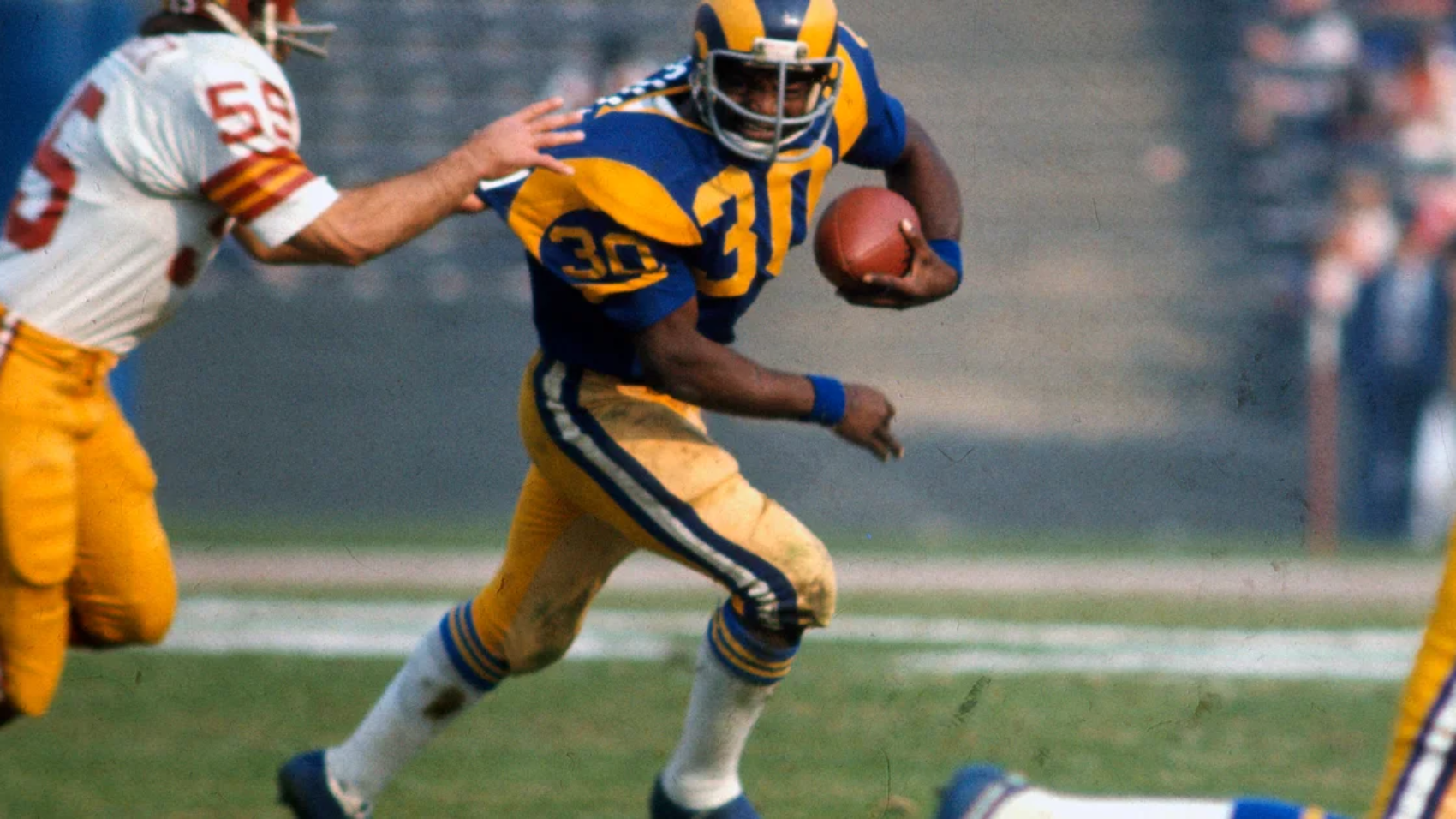
It’s also worth remembering that even Coach McVay never had to deal with a situation like Wendell Tyler’s. Fumble Tyler” struggled with fumbles throughout his career despite being an explosive, slice and dicer and productive player. However, in 108 games, he had 64 fumbles, including 37 during his time with the Rams. In 1982, he led the NFL with 11 fumbles on just 137 carries, and he had multiple double-digit fumble seasons, including a career-high 13 in 1984.
Regardless of my P.T.S.T., if Smith wants to hold onto a meaningful role, he has to never fumble again.
Therefore, this is where the bigger issue comes into focus. If anything happens to Nacua or Adams, and that’s always a real possibility, the Rams are suddenly relying on unproven depth. Building a season around the assumption that your top two receivers will stay healthy the entire way is not a smart strategy, but again, that’s my view, not the coaches’. I never think in terms of injury which again, is not smart.
That’s why the wide receiver conversation isn’t as simple as it looks, and it’s why I may be wrong about what to do at No. 13. It’s not about replacing the top; it’s about whether the Rams trust what’s behind it. Right now, that trust feels uncertain, and how this group develops, or fails to, could quietly become one of the defining factors of their season. I get it now.
Also, this is a team built around Matthew Stafford, a quarterback whose presence defines both the ceiling and the timeline of the organization. Every decision made at this stage must serve the dual purpose of maximizing his effectiveness while extending the viability of the system around him. Adding another wide receiver at No. 13 does little to address the structural components that ultimately determine offensive success. I think tghat protection, continuity, and control at the line of scrimmage carry significantly greater weight right now than incremental upgrades in skill-position depth, particularly for a team operating in a win-now phase.
That is why the growing conversation around the offensive line is not only logical but necessary. The Rams are at a point where reinforcing the front is no longer optional; it is foundational. Changes along the line, combined with the natural wear associated with veteran players, have created a situation where long-term stability must be prioritized alongside immediate functionality. Selecting a high-level offensive lineman at No. 13 would not simply fill a vacancy; it would establish a cornerstone. It would provide the type of reliability that allows the rest of the offense to function at its highest level, and it would do so in a way that aligns with both present and future objectives. Setting everything aside, we need a starter and additional depth on the offensive line.
Equally important is the flexibility such a move provides. By addressing the offensive line early, the Rams free themselves to approach the remainder of the draft with greater precision. Mid-round selections can then be allocated toward depth and development rather than necessity, which is where teams often find the greatest value. Prospects projected in the second and third rounds offer legitimate starting potential at positions like guard and edge, allowing the Rams to build out the roster without forcing early-round decisions that may not represent optimal value.
The defensive side of the equation introduces another layer to this discussion, particularly with the continued speculation surrounding Bobby Wagner. The connection is understandable. The Rams have a clear need at linebacker, and Wagner represents a known commodity with the experience and intelligence to stabilize the middle of the defense immediately. His previous tenure with the team, combined with his continued productivity, makes him an attractive short-term solution for a roster seeking consistency. However, it is essential to frame this potential move accurately. Wagner is not a long-term answer; he is a calculated addition designed to raise the floor of the defense in the present.
If the Rams do move forward with that type of signing, it further reinforces the argument against using a premium draft pick on a linebacker. The presence of a veteran stabilizer allows the team to approach the position developmentally rather than urgently, targeting younger, more athletic players in later rounds who can grow into larger roles over time. This approach not only maximizes value but also aligns with the broader objective of maintaining flexibility across the roster.
Beyond Bobby Wagner, the Los Angeles Rams have several legitimate alternatives still available in free agency, and the decision is not as one-dimensional as it may seem. There are high-end options like Devin White and Devin Bush, who bring significantly more speed and range to a modern defense, offering higher upside even if they come with some inconsistency.
Then there are more balanced, reliable options such as Germaine Pratt and Bobby Okereke, who provide steady production, three-down capability, and a blend of athleticism and discipline that may ultimately make them the smartest overall fits. Beyond that tier, veterans like Jerome Baker, Anthony Walker Jr., Shaq Thompson, and Matt Milano remain viable contributors who can stabilize a defense without commanding top-tier investment, though they profile more as complementary pieces than true difference-makers.
What this ultimately shows is that the Rams are not locked into Wagner as their only solution; they have options that range from safe and familiar to athletic and high-upside. The decision, then, is philosophical as much as it is tactical—whether to prioritize stability and experience for a short-term push, or to inject speed and versatility into the defense in a way that better aligns with the modern NFL.
If the Los Angeles Rams ultimately don’t land Bobby Wagner, the next most logical path would be targeting a younger, more athletic linebacker who can contribute across all three downs. A player like Germaine Pratt stands out as one of the smartest alternatives, offering consistent tackling, strong instincts, and the ability to stay on the field in both run and pass situations without the age-related limitations that come with a veteran like Wagner. Another intriguing option could be Devin White, whose speed and explosiveness would immediately add a different dimension to the Rams’ defense, even if his game comes with some inconsistency.
The decision ultimately comes down to philosophy: if Los Angeles wants stability and reliability, Pratt is the cleaner fit; if they are looking to raise the defense’s overall ceiling and inject more athleticism, White becomes the more aggressive, high-upside choice. Either way, the Rams are not short on viable alternatives, and missing out on Wagner would not leave them without a clear path forward.
Maybe I’m questioning how sold I really am on bringing Bobby Wagner back to the team. He did play here in 2022, so there’s familiarity, or not really since it was a one off, and I’d expect his salary to land somewhere around $9 million, which isn’t unreasonable. That said, this only makes sense if the structure is right, ideally a two-year deal firm with a potential third-year option, depending on how long he can continue to play at a high level.
From my perspective, the key isn’t just the price, it’s the commitment but I also get the short shelf life.
Perhaps the most intriguing aspect of the current discourse is the possibility of the Rams trading out of the No. 13 spot altogether. I don’t like that idea, but while the accumulation of additional draft capital is always appealing, especially for a team that has been aggressive in previous transactions, the context of this decision cannot be ignored. In fact, that’s exactly what the NFL.com mock draft has them doing this year, which honestly has me laughing out loud. Still, moving down the board introduces a level of uncertainty that may not be justified given the Rams’ current position. At No. 13, they are within range of securing a player who can contribute immediately at a high level. I want to find an explosive Defensive Lineman.
If they were to follow that mock draft projection, they would slide back to No. 17 and, in that scenario, select a wide receiver from Indiana. I’m not sure how much I like that move. Sliding back, even by a few spots, risks losing access to top-tier talent in exchange for assets that may not provide equivalent impact.
Or do you still take the best player on the board at No. 13? That’s the strategy for some teams, but I’d prefer to find a defensive player who can start from day one.
For a team with legitimate postseason aspirations, the emphasis should remain on securing difference-makers rather than maximizing volume. Depth is important, but top-end talent is what defines playoff success. The Rams have already demonstrated a willingness to invest heavily in key areas of the roster; this draft presents an opportunity to complement those investments with a player capable of anchoring a critical position group for years to come.
Ultimately, the direction the Rams choose at No. 13 will serve as a clear indicator of how they view their current trajectory. A selection focused on the offensive line signals a commitment to sustaining their competitive window through structural strength and long-term planning. A move toward wide receiver suggests a prioritization of offensive versatility and future flexibility, albeit with greater immediate risk. A trade-down reflects confidence in their ability to identify value deeper in the draft, but also introduces variables that may not align with a win-now mandate.
The noise surrounding the Rams’ draft strategy will continue to build as April approaches, but beneath that noise lies a decision that is both simple and significant. This is not about chasing trends or reacting to projections. It is about understanding where the team stands, what it needs, and how best to position itself for both immediate success and sustained relevance. The Rams are not searching for answers; they are choosing a direction. And at pick No. 13, that choice has the potential to shape not only this season, but the next phase of the organization as a whole.
The funniest thing about the NFL in March is how quickly chaos gets mistaken for truth. A rumor catches one gust of wind, gets repeated often enough, and suddenly people start talking about it like it was a front-office master plan all along. I got a notification about it on my phone during a very confusing breakfast. Not only was the rumor confusing, but I was also baffled that this breakfast place thought it was acceptable to cook waffles in a microwave. But anyway, that is exactly what happened with the Los Angeles Rams and the Davante Adams noise over the weekend.
Let’s shut that down right away.
Davante Adams was not “going somewhere.” He was not on some clear runway out of Los Angeles. He was not being lined up in any direct swap for A.J. Brown. And if that rumor had been presented as a certainty from the beginning, it deserved to be challenged from the beginning. The only specific report that the Rams were exploring moving Adams while looking into Brown came from a single league-source report, while separate reporting confirmed Los Angeles had legitimate interest in Brown without broad, independent confirmation of some full-blown, organized Adams exit plan. Sean McVay had already said in February that he “absolutely” expected Adams back and had no reason to believe otherwise, which makes the louder version of the rumor look even shakier now.
And then came the simplest reality check of all: Adams’ $6 million roster bonus hit on March 16, and the Rams let it hit. That does not magically prove there were never exploratory conversations anywhere in the background, because teams check on everything this time of year. But it absolutely does mean the breathless version of the story got ahead of the facts. If the Rams truly had some urgent, committed plan to dump Adams, they did not execute it before that trigger date. Instead, they moved forward with him still on the roster, still tied to Matthew Stafford, and still sitting in the middle of a passing game that was one of the most dangerous in football when healthy.
Let’s also clear something up for the geniuses pushing that rumor. In the 2025 NFL regular season, Davante Adams led the entire league in receiving touchdowns with 14 while playing for the Los Angeles Rams. A player producing at that level was never realistically going anywhere. The idea that the Rams were preparing to move on from the league’s touchdown leader never made sense to begin with.
Even after missing the final three games of the season with a hamstring injury, Adams still finished the year with 60 receptions for 789 yards and those league-leading 14 touchdown catches, proving once again how dangerous he remains in the red zone and in high-leverage situations.
His performance also made history, as he became the first player in NFL history to lead the league in touchdown receptions with three different franchises—the Green Bay Packers, the Las Vegas Raiders, and now the Los Angeles Rams. When you step back and look at the production and the chemistry he developed with Matthew Stafford, it becomes obvious why the Rams had no real reason to move him.
The plan is already in place, and Adams remains a major part of it. That matters, by the way, because once you stop reacting to rumors and actually look at the roster, the Rams’ offseason becomes much easier to read. Everything is much clearer now.
This is the part where everything changes.
A few days ago, it was fair to stare at this team and think cornerback had to be a Day 1 draft priority. That was the glaring hole. That was the spot people circled. That was where I was most angry after the year ended. That was the part of the defense that felt unfinished. Then the Rams went out and changed the entire conversation in a hurry. They traded for Trent McDuffie, gave him a four-year extension worth $124 million, signed Jaylen Watson to a three-year deal, and brought back Kam Curl. In one wave, they turned the secondary from the weak point into a strength. More importantly, they did exactly what Les Snead says he wants to do every year: use free agency and trades to remove desperation from the draft.
That is why this week feels different now that I had to breathe and think about our plan.
This is not a roster screaming for rescue anymore. This is not a roster begging to be patched together. This is a roster that already looks like a force and now gets to draft from a position of comfort instead of panic—or better yet, desperation—or both is where we were at two weeks ago.
Right now, the roster is solid at almost every level, and it’s wild how locking down the cornerback position—what I consider the most difficult position in football to execute successfully—can change the entire outlook of a defense.
When that spot is secured, the entire defense becomes stronger, even beyond the defensive backs themselves. It changes how everything functions. Because of that, I’m not even sure the Rams need to force an edge rusher anymore. That was originally my thinking when the team had two first-round picks before using No. 29 in the trade for Trent McDuffie. But now the equation looks completely different.
Remember too, Byron Young and Jared Verse are nothing to sneeze at. Both are edge rushers for the Rams and are already becoming imposing forces on that defensive front.
The Rams still hold the No. 13 overall pick, the one they originally acquired from Atlanta, even after sending their own No. 29 pick to Kansas City in the McDuffie trade. So instead of using that premium selection to chase a need at corner, the Rams can aim higher. They can take a genuine difference-maker. They can target somebody who changes games right away. They can draft impact, not survival.
That is why the entire draft board should be viewed through a different lens now. By that, I mean I see it very differently than I did even a few days ago.
The Rams do not need to force a corner. They do not need to force safety. They do not need to reach for another flashy receiver just because there was one wild week of internet noise around A.J. Brown. The offense already got an important bit of stability with Tyler Higbee returning on a two-year deal, and the bigger point remains the same: if Stafford is upright and Adams and Puka Nacua are both on the field, this offense is not lacking headline talent for up to three more years of togetherness. The Rams’ own site acknowledged that, after free agency, mock drafts suddenly had them linked to more offensive weapons at No. 13 because the earlier pressure to fix the secondary was gone. But that is where the Rams now have flexibility instead of obligation.
And that brings us to the real football conversation.
After taking that breath, letting the shock of the cornerback moves wear off, and laying the whole roster out to look at it straight on, the Rams really don’t need much in terms of figuring out what the team still needs—if that makes sense. In other words, everything is much more concise now.
They need the right thing.
There is a difference.
That is why the entire draft board should be viewed through a different lens now. And by that, I mean I’m looking at it very differently than I was even a few days ago. I was honestly trying to push thinking about it off a few more weeks.
If there is an elite edge player sitting there at No. 13 who can arrive as an immediate closer, then that is still a very clean answer. Nobody should ever apologize for adding a pass rusher who can end drives, finish games, and tilt a playoff pocket in the fourth quarter. There is no such thing as too much pressure when January football arrives.
But the more interesting development is this: now that the back end has been fortified, the Rams may not have to force the outside pass-rush conversation the way some people assumed.
Like we mentioned, Jared Verse is already in house. Byron Young is already in house. Remember, those two are nothing to sneeze at. They are legitimate edge rushers and imposing forces already developing on this defensive front. Both are also still growing, and both stand to benefit from tighter coverage behind them. Better corners can buy a defensive front an extra beat, and in the NFL that extra beat is often the difference between a pressure and a sack. We saw that for years when Aaron Donald was collapsing pockets—quarterbacks simply didn’t have time. By the Super Bowl, that defense was swallowing up offenses, walking through the line and stopping plays before they could even develop behind the line of scrimmage.
So if the Rams do stay on defense at No. 13, the most compelling non-edge idea may actually be the one that is finally starting to come into focus: an inside disruptor. A true interior difference-maker who can impact the game on Day One.
That is the shift.
Not because edge suddenly stopped mattering. It always matters. But because the Rams no longer have to shop from desperation, they can think more specifically about how to make a good defense become a scary one.
An interior force next to Kobie Turner could completely change the geometry of the defensive front. It could collapse the pocket faster, muddy the quarterback’s sightlines, and create cleaner one-on-one matchups for the edge players already on the roster. If the right interior defender is there, the Rams should absolutely be open to that. They should not draft for the old hole when the old hole has already been filled.
At the same time, the Rams still need to think about finding Day One game breakers.
That is the real challenge facing Les Snead right now. Finding a “Day One Game Breaker” at No. 13 while simultaneously planning for the post-Matthew Stafford era is the needle he has to thread. If you want a player who can change the game the second he steps onto the field, the board usually splits into two directions.
The first path is the defensive game breaker.
If Arvell Reese is there at 13, he is exactly that type of player. He is one of the most explosive defensive prospects in the 2026 class and has been ranked among the top edge or outside linebacker prospects in the draft by multiple major evaluators. His burst forces quarterbacks to throw earlier than they want to, which directly benefits the secondary. That is exactly how corners like Trent McDuffie and Jaylen Watson end up with interceptions—quarterbacks rush throws because the pressure is real. Reese’s explosiveness and block-destruction ability are the exact traits teams chase when they want a defender who changes the math of a game.
The comparison everyone makes when they talk about a closer is Von Miller, and that is not accidental. If the Rams want that kind of game-tilting presence, Reese is one name, but he is not the only one. David Bailey out of Texas Tech, Rueben Bain Jr. out of Miami, R Mason Thomas out of Oklahoma, and T.J. Parker out of Clemson are all part of the real 2026 edge conversation and all fit the broader point here: if Los Angeles wants a true heat-seeking pass rusher at 13, this class does offer them legitimate options.
But there is also the second path the Rams cannot ignore: planning for life after Matthew Stafford.
Depending on how the next one to three years unfold—and depending on Stafford’s health—the Rams eventually need someone ready to take over. If a quarterback unexpectedly slides, the Rams may need to consider that option.
Ty Simpson from Alabama could fit that type of developmental mold. He has the arm talent and the pocket-passing skill set that make the Stafford comparison understandable, and he is already viewed as one of the better quarterback prospects in this class. Carson Beck is another possibility if the board gets strange, and there are evaluators who also like the broader top of this quarterback group built around names like Fernando Mendoza and Garrett Nussmeier. But the larger point stays the same: if the Rams are thinking long term, the successor conversation is real, even if the timing has to be right.
Let me be clear about one thing: the Rams should not be drafting a quarterback with the No. 13 pick. That pick needs to be reserved for a true Day One game breaker—someone who can impact the roster immediately, whether that’s an elite edge rusher or a dominant defensive lineman. The goal at that spot is to strengthen a team that already looks like a contender, not to reach for a long-term project when there are still players available who can make an immediate difference on Sundays.
That doesn’t mean the quarterback conversation disappears entirely. It just needs to happen at the right point in the draft. Ideally, the Rams would look for a developmental quarterback later—somewhere around the fourth round if the board breaks the right way. That gives the team a young player who can begin learning Sean McVay’s system without the pressure of having to play immediately, especially with Matthew Stafford still firmly in control of the offense. The same logic applies to the kicking situation. The Rams should absolutely address that as well, but it belongs in the middle-to-late rounds—somewhere in the fourth or sixth round—where they can bring in competition without sacrificing premium draft capital.
The key to this entire strategy is that the Rams still held onto their second-round pick (No. 61), and that is huge. Even after making the aggressive move to acquire Trent McDuffie, keeping that pick gives Les Snead flexibility in the sweet spot of the draft. That is the range where the Rams could grab a high-end offensive tackle to protect Stafford, or even take a calculated swing at a future quarterback if someone like Ty Simpson or Carson Beck happens to slide further than expected.
When you step back and look at the draft capital the Rams still hold, the plan becomes pretty clear. The first round is where they should hunt for the big impact player. The second round becomes the insurance policy—either reinforcing the offensive line or taking a developmental quarterback if the value lines up. The third round adds depth, likely somewhere in the defensive backfield or linebacker group, and the late rounds are where the Rams can finally address special teams and stabilize the kicking situation.
So the draft “war chest” now looks something like this:
Round 1 (No. 13): The game breaker—edge rusher or defensive line disruptor. Round 2 (No. 61): The insurance—offensive tackle or developmental quarterback. Round 3 (No. 93): Depth—possibly safety or linebacker. Late rounds (6–7): Special teams help, including a kicker.
Yes, the Rams did give up their fifth-round pick in the trade package with Kansas City, but holding onto that second-round selection keeps the entire strategy intact. With that pick still in hand, Les Snead has enough ammunition to be dangerous—and more importantly, enough flexibility to keep building a roster that already looks much closer to complete than it did just a week ago.
There is even a wild-card offensive scenario if the Rams decide to lean fully into overwhelming firepower.
Denzel Boston from Washington is a 6-foot-4 receiver who would create absolute nightmares in the red zone, and Carnell Tate from Ohio State is another one of the top wide receivers in this class. Imagine a red-zone offense featuring Davante Adams, Puka Nacua, and another big-bodied target with that kind of size—not to mention Tyler Higbee at tight end, who is huge as well. Stafford wouldn’t have to thread needles anymore. He could simply throw the ball where only his giant target could reach it. That is the kind of move that could extend Stafford’s career, because it reduces the need for perfect throws and tight-window passes.
Of course, there is also a completely different type of “game breaker” the Rams desperately need to address: special teams.
Last season, special teams were awful across the board. That cannot happen again if this team expects to compete deep into the postseason. A real special-teams game changer might not even be a kicker—it could be a return specialist. One that does not fumble would be ideal.
A late-round speed threat like Zachariah Branch could flip field position instantly and give the Rams something they have lacked for years: explosive return yardage that sets the offense up with short fields.
And yes, offensive line depth still matters. It always matters. Every year, every team has to address its offensive line situation. There was a time when the Rams rarely had to worry about it because they had players who stayed with the team for decades as offensive linemen. There was even a stretch when the team had essentially the same offensive line for about six years in a row. Maybe longer.
If the top defensive playmakers are gone, the Rams could pivot to offensive tackle. The current 2026 tackle class is led by names like Francis Mauigoa, Spencer Fano, Monroe Freeling, Caleb Lomu, and Kadyn Proctor. Those are the types of players who could anchor the offensive line for years while protecting Stafford’s blind side.
Right now on defense, the Rams are leaning heavily on Byron Young and Jared Verse as their primary edge rushers. They have both shown promise, but neither has yet demanded consistent double teams. Adding a blue-chip edge player would finally give the defense that fear factor coming off the outside.
And if the Rams—meaning me—truly want that Von Miller-type impact player, the guy who can take over a game in the fourth quarter, then Arvell Reese, David Bailey, or R Mason Thomas are the names that now belong in this conversation, not the ones from last year’s class. That is the correction. That is the real 2026 conversation. And that is the kind of player who could push this defense over the hump.
But even without that addition, the reality is this: the defense might already be in a better position than people realize.
With Trent McDuffie leading the secondary, coverage should hold longer. That gives players like Jared Verse and Byron Young an extra half second to get to the quarterback. In the NFL, that half second can be everything.
Meanwhile, Kobie Turner is still ascending after recording nine sacks as a rookie.
So yes, the defense is already good.
But if the Rams hit on the right player at No. 13—whether that’s an elite edge closer, a dominant interior disruptor like Peter Woods or Caleb Banks, or even a long-term quarterback successor—the defense and the roster as a whole could become something much more dangerous. Woods and Banks, in particular, are among the more highly regarded interior defensive linemen in the actual 2026 class, and both fit the broader idea of adding force next to Kobie Turner instead of chasing an old need that has already been addressed.
And that is the real point here. The Rams no longer need to draft from panic. They can draft for impact.
That is why the post-trade version of this team is easier to understand than the pre-trade version.
The cornerback trade did not just improve the secondary. It simplified the Rams’ identity for me at least. It made this part of my life and job a lot easier and much more concise.
Now you can see the remaining checklist for what it really is.
To be clear, offensive line still matters because offensive line always matters. Stafford is the center of the whole operation, and the Rams have made it clear their entire 2026 approach is about maximizing the window with him. His $40 million salary for 2026 became fully guaranteed on March 16, which tells you everything you need to know about the organization’s commitment to the current timeline. This is not a patient, long-horizon reset. This is a win-now team. And win-now teams do not get cute about protection. They keep feeding the line, even when the line looks solid. If the Rams use one of their five picks on an offensive lineman, nobody should blink. If they use two, even better.
That said, No. 13 feels too valuable now to spend on a mere insurance policy unless the board falls in a very specific way. That pick should be for a real immediate-impact player. Somebody who can be felt right away. Somebody who adds violence, disruption, or stability at a level this roster cannot currently match. That is why the conversation comes back to the front seven more than anything else. If there is a true Day 1 force available, that is the luxury of what the Rams have created for themselves with the McDuffie-Watson-Curl stretch. They have earned the right to swing for impact.
Special teams, meanwhile, remain the area fans are most justified in distrusting. That needs to be discussed and addressed like yesterday too.
The Rams did make a meaningful move there by signing long snapper Joe Cardona to a two-year deal, and that matters more than casual fans often admit. Good special teams start with execution, and execution starts with reliability. But stabilizing the snap does not solve the broader anxiety. It does not erase the memory of missed extra points—unless the issue somehow traces back to the center from last year—because our kickers missed plenty of field goals and extra points last season. It does not suddenly create full confidence in the kicking game. It simply means one piece of the special-teams mess has been addressed.
That brings us to the kicking situation, which still needs to be addressed, even if the Rams have already taken a step toward stabilizing it.
Joshua Karty is no longer part of the picture after being waived, which means the Rams have effectively turned the page and are now looking toward Harrison Mevis as the current option in the building. The team tendered Mevis as an exclusive rights free agent on March 2, securing him for the upcoming season after he was initially added to the practice squad in November of 2025.
Mevis, known as “The Thiccer Kicker,” already has a bit of a reputation for that massive leg strength, and honestly he reminds me a little of Tom Dempsey. That comparison is only half joking, but it fits when you watch the way he can drive the ball. He has the type of leg that can hit from deep range without much hesitation. After a strong 2025 season in the UFL with the Birmingham Stallions, where he went 21-for-23 on field goals, the Rams clearly saw enough to bring him into the organization and keep him under contract.
But leg strength has never really been the Rams’ problem.
The issue has been reliability.
Last season the kicking situation became a headache because the misses weren’t coming from impossible distances—they were coming on the kicks that should be automatic. Extra points. Short field goals. Those are the ones that drive myself and Coach McVay crazy, and they should. Missed PATs change the entire flow of a game. Suddenly coaches are chasing points, going for two earlier than they want to, and making strategic decisions they shouldn’t have to make.
That’s why kicker still belongs somewhere on the draft board, even if it’s not anywhere near the top.
The Rams can absolutely live with a late-round solution here. A sixth- or seventh-round kicker would make perfect sense, especially if the front office wants real competition in training camp, which we need to have this year. Bring in another leg, let him compete with Mevis, and make it very simple: the guy who makes the kicks stays.
Special teams are one of those areas that people love to ignore until they start costing games. And last season proved how quickly those problems can snowball. Field-position swings, missed points, momentum shifts—it all adds up.
So while the Rams don’t need to panic about kicker the way they did about the secondary earlier this offseason, they still need to finish the job.
If Mevis becomes the answer, great. If a late-round rookie wins the job, even better. Either way, the Rams cannot go into a season with Super Bowl expectations and pretend that special teams are an afterthought.
Because when everything else on the roster is starting to look this complete, the smallest details suddenly become the ones that decide championships.
And last, there is the longer-range issue sitting quietly behind all of this.
Eventually, whether the window is one year, two years, or three, the Rams are going to have to think about life after Stafford. That remains true no matter how aggressive the current offseason has been. But that does not mean the successor conversation has to hijack this particular moment. The roster now is strong enough that the primary responsibility of pick No. 13 should be helping the 2026 Rams, not just the 2028 Rams. The quarterback succession plan can develop on its own timeline if the board does not present something extraordinary. Right now, the main story is simpler: Los Angeles has done enough early work to make the first round about adding force, not filling fear.
Which is exactly where we want to be.
Today at the Sunset Entertainment & Media Companies
The Los Angeles Rams entered the 2026 offseason in a position that I personally find great from a roster-building standpoint. They have exceeded anything I anticapted by leaps and bounds. After watching them make that deep playoff run to reach the NFC Championship Game, I came away with the feeling that this team isn’t entering a rebuilding phase at all. In my view, they are doing exactly what a contender should do after falling just short — they are adjusting, reinforcing weaknesses, and trying to maximize what is still a very real championship window.
As the 2026 NFL league year officially opens Today, several of the Rams’ offseason moves became finalized, including key contracts, trades, and roster adjustments that had been building throughout the early days of free agency. When I step back and look at the bigger picture, I don’t see random transactions or short-term decisions. What I see is a deliberate attempt to strengthen specific parts of the roster while keeping long-term flexibility intact.
Even the Quarterback issue can be stretched for up to three years if every thing moves forward the way its moving now. From my perspective its been pretty clear, the Rams approached this offseason with a clear objective: improve the defense, especially reinforce the secondary, stabilize special teams, and maintain the offensive structure that helped them reach the NFC Championship Game in the first place.
There’s an odd dichotomy to how last season ended, and despite the frustration that still lingers in my brain, the Seahawks winning the Super Bowl ultimately is appropriate when everything was said and done. At the same time, I can’t shake the feeling that the team actually peaked somewhere around Week 9, give or take. From my perspective, the rest of the season often felt like we were chasing that earlier level of perfection once the injuries started piling up and mnoreover, when they were healed to come back to play.
Even when players began returning and the roster slowly got healthier, the team never quite managed to recapture that same rhythm. It was choppy. We would let up a ton of points but score more most games. By the time the final game arrived, they looked exhausted. They were barely covering recievers those games. And yet the irony of the entire season is that they still could have won not only that last game, but also most of the games they ended up losing along the way. Aside from maybe one matchup, nearly every loss felt like a game the rams either could have won — or in some cases, probably should have. Too often, they didn’t get beaten as much as they handed those games away. That is what angered me to no end last season.
That’s why, when I look at the moves the organization has already made this offseason, I can’t help but feel totally encouraged. The Rams clearly aren’t listening to me Thank God and nor are they standing still. In fact, they’ve already surpassed my admittedly terrible idea of simply waiting until the draft to address the cornerback issues. Instead, what I’m seeing is a front office that took of those iisues in weeks or better yet, in one day if consider the year jusdt starts today.
The Rams, of course, had to prioritize defensive versatility because if you think back to their playoff run, one of the biggest things that stood out was how important defensive adaptability is in the modern NFL. I’ve even called cornerback the most impossible position in football. At that spot, you almost have to allow for a huge percentage of mistakes — giving up catches, touchdowns, and even big plays — because that’s simply the reality of the position. Even the best defensive backs in the league will still allow plenty of touchdowns over the course of a season.
That said, you still need players who can make big plays when it matters. Someone like Jalen Ramsey is a perfect example of that, because you really can’t criticize the play at that position unless the cornerback simply gives up on it. Unfortunately, we had players who did exactly that this year. Just think about the Hail Mary in the playoff game, or the number of times opposing wide receivers were several steps ahead of our cornerbacks. That wasn’t normal.
On top of that, the league right now is dominated by explosive passing attacks, creative offensive play design, and quarterbacks who are more than capable of exploiting even the smallest coverage breakdown.
Because of that, I believe the Rams entered this offseason knowing their secondary needed to become more versatile and more aggressive.
To me, the most striking element of their offseason so far is how aggressively they addressed the cornerback position.
The Rams didn’t just tweak the secondary — they completely reshaped it. They also did it in one day if you consider the Season 2026 started today.
The biggest move of the Rams’ offseason, is clearly the trade for All-Pro cornerback Trent McDuffie.
When I first saw this move come together, my immediate reaction was that the Rams were sending a very clear message about their priorities. They wanted a true difference-maker in the secondary — someone capable of locking down receivers, playing multiple coverage roles, and bringing an edge to the defense.
McDuffie fits that description perfectly.
From what I’ve seen watching him play, he’s one of the most complete defensive backs in the league. He can play outside corner, move into the slot, blitz when needed, and contribute in run support. Those kinds of players are incredibly valuable in today’s NFL because they give defensive coordinators the freedom to disguise coverages and create pressure in different ways.
The Rams didn’t just acquire McDuffie — they also made a major long-term commitment to him with a $124 million contract extension that includes $100 million guaranteed. That deal makes him the highest-paid cornerback in NFL history, which tells me the Rams see him as a cornerstone of their defense moving forward.
From my perspective, this move immediately raises the ceiling of the entire Rams defense.
Then, adding Jaylen Watson makes the secondary even stronger again, at the drop of a dime. What I find especially interesting is that the Rams didn’t stop after landing McDuffie. They went right back to the same pipeline and added another former Kansas City defensive back — Jaylen Watson. I never saw that coming.
Watson agreed to a three-year deal worth $51 million with $34 million guaranteed, and I see him as an excellent complement to McDuffie.
Where McDuffie offers versatility and coverage instincts, Watson brings size and physicality on the outside. I think that combination by far gives the Rams a much more balanced cornerback group than they had previously. It is not even close. From my perspective, Watson has the type of skill set that allows him to match up against bigger receivers, disrupt routes at the line of scrimmage, and challenge contested catches.
With both Watson and McDuffie now in the lineup, the Rams secondary has the potential to become one of the more dynamic defensive backfields in the NFC.
Keeping Kam Curl is another smart move because, if nothing else, he made some big plays this year. He was noticeable right away and remained visible throughout most of the season. Overall, I thought he played well.
While the additions to the secondary grabbed headlines, I personally think one of the most important decisions the Rams made was re-signing safety Kam Curl. Curl agreed to a three-year deal worth $36 million, with the potential to reach $39 million and $24 million guaranteed. When I look at that contract and compare it to his impact on the field, I see tremendous value.
Curl is also exactly the type of player every modern defense needs. He can play deep safety, support the run, blitz off the edge, and rotate into different coverage responsibilities.
That kind of versatility is incredibly important because it allows the defense to disguise its intentions before the snap.
When I watch Curl play, I see someone who understands the flow of the game and can react quickly to offensive adjustments. Keeping him in Los Angeles ensures that the Rams maintain continuity in the secondary even as they introduce new pieces.
Another move that stood out to me was the return of Tyler Higbee, who remains one of the longest-tenured players on the Rams roster. Higbee signed a two-year deal worth up to $8 million, and while that may not be the flashiest move of the offseason, I personally think it’s an important one. We were choosing between many Tight Ends in teh first place and we have eyes on one in the upcoming draft.
From my perspective, Higbee brings something every successful team needs: experience and leadership, along with being a solid player. He just needs to stay healthy, which seems to be difficult for him every year. Even when injuries limited his playing time last season, he remained a trusted presence within the offense. He understands the Rams’ system, knows how to read defenses, and provides stability within the tight end group. But again, we had two other tight ends who also played well last season.
I also think his presence benefits younger players in that position room. Having a veteran who understands preparation, film study, and game-day adjustments can accelerate the development of younger teammates. I do not really want Higbee to go anywhere. I would love for him to play out his career here with the team.
For those reasons, I believe bringing Higbee back was a solid move.
One of the quieter moves that I actually find interesting is the signing of long snapper Joe Cardona, a two-time Super Bowl champion. Special teams rarely receive the same attention as offense or defense, but in my experience analyzing the game, those units often determine the outcome of close contests. Our Special Teams last season was horrible on every level.
Cardona developed a reputation in New England as one of the most reliable long snappers in football. Beyond his technical consistency, he’s also known as a respected leader.
As a graduate of the United States Naval Academy, he also brings discipline and professionalism that coaches value tremendously. Adding a veteran like Cardona helps stabilize the entire kicking operation — from punts to field goals to extra points.
Those are the types of moves that may not dominate headlines but can make a huge difference over the course of a season. In our case, it solves alot rather fast.
There are also other depth moves that I believe help stabilize the roster, in addition to the bigger signings and trades, the Rams also made several smaller moves that I believe help maintain roster stability.
Wide receiver Xavier Smith, offensive lineman Justin Dedich, and kicker Harrison Mevis were all retained through exclusive rights tenders.
I’m still on the fence when it comes to Xavier Smith, but if he can prove that he’ll catch the ball 100% of the time when fielding a kick or punt on special teams, I’d love to be proven wrong there at least. Right now, I don’t fully trust it, but I do see the potential — especially if he can eliminate the drops and never mishandle another punt or kick return again.
The same goes for Harrison Mevis, whom I refer to as the poor man’s Tom Dempsey. He still needs some work. Like I alluded to just above, I think it’s his style that really throws me off. At the same time, he does perform well, and he did a solid job last season. Still, I felt on edge with every field goal or extra point attempt. Maybe the Josh Karty situation scarred me a bit, because I still can’t believe how poorly that turned out. I really thought Karty had the potential to become one of the best kickers in the league, but he ended up missing more than he made and was eventually benched. I feel awful about that situation.
Therefore, right now I’m still on the fence about our kicking game. I feel like we need a more sure-handed player — someone we can truly count on and depend on without feeling nervous every time he lines up for a kick. I would still allow Mevis the chance to prove me wrong here, which I would welcome, but I also feel like we may see some movement at that position during the offseason.
While these moves might not generate major headlines, I personally see them as important for maintaining depth across the roster.
Smith does offer receiving depth and special teams contributions if does not fumble, Dedich provides versatility along the offensive line which was very supsect last season, and Mevis did prove himself to be a remarkably reliable kicker last season. It just was not pretty on all levels here but they did do well in broad scheme of things.
So, keeping players like this around allows the Rams to maintain continuity while focusing their bigger investments on premium positions.
Most imprtantly is why Offensive Line depth is still an issue and therfore another move I found notable was the decision to bring back David Quessenberry, who provides depth along the offensive line.
For teams with championship ambitions, offensive line depth is something I always pay attention to. Especially with Matt Stafford at quarterback, who is not a runner and needs to be protected from the defense, that protection is key to our ability to win a Super Bowl this year. The problem is that injuries at that position are almost inevitable during a long NFL season, and having experienced players ready to step in can make a huge difference. We simply did not have that this year by any means, and I felt horrible about it (it was cringe worthy at times watching our Offenseive Lineman).
Quessenberry may not always be in the spotlight, but his ability to serve as a swing tackle provides valuable insurance behind the starters.
In my opinion, moves like this reflect the Rams’ understanding that roster depth is just as important as star power.
One development was the retirement of cornerback Darious Williams, who stepped away from the NFL after eight seasons. His decision also created financial flexibility for the Rams by freeing roughly $7.5 million in salary cap space.
Another longtime Ram, offensive tackle Rob Havenstein, also chose to retire earlier in the offseason. Havenstein had been a key piece of the Rams offensive line for years and played an important role during the team’s Super Bowl run.
There were also changes on the coaching staff. Mike LaFleur departed to become the head coach of the Arizona Cardinals, prompting the Rams to promote Nate Scheelhaase to offensive coordinator.
That promotion signals the organization’s desire to maintain offensive continuity while introducing new ideas within the system.
What is left if you consider the draft capital and salary cap flexibility that stll give the Rams options? Because even after making several major moves, the Rams remain in a strong position financially.
The 2026 NFL salary cap has been set at $301.2 million, the highest in league history, and the Rams entered the new league year with approximately $42 million in available cap space. As of the start of the 2026 league year today, March 11, 2026, the Los Angeles Rams have approximately $20.5 million in available salary cap space.
This figure has fluctuated significantly over the last 48 hours as high-profile signings and trades became official:
Starting Point: The Rams entered the week with roughly $42 million in cap space following the league’s announcement of a record $301.2 million total salary cap.
Key Cap Reductions:
Trent McDuffie: His acquisition added a $13.63 million hit for 2026 (the cost of his fifth-year option).
Kamren Curl: His new extension carries a $8.4 million cap hit for the 2026 season.
Jaylen Watson: The former Chiefs cornerback adds roughly $6.9 million to the 2026 cap.
Cap Savings:
Darious Williams: His retirement earlier this week saved the team $7.5 million.
Current Standing: After factoring in these moves and other tenders (such as ERFA tenders for Harrison Mevis and others), the Rams’ current cap space sits at $20,481,323.
Top 2026 Cap Hits: The Rams’ current financial landscape is dominated by five major contracts:
Note: The Rams can still generate over $50 million in additional space through “simple restructures” of the Stafford, Adams, and Jackson contracts if they choose to make another big move in free agency. That level of flexibility gives the front office room to continue making adjustments if opportunities arise.
The Rams also still possess seven selections in the 2026 NFL Draft, including a valuable 13th overall pick acquired from Atlanta.
The team also received two seventh-round compensatory selections, giving them additional opportunities to add developmental talent later in the draft.
Retaining that first-round pick at No. 13 while still acquiring McDuffie was an extremely important part of the Rams’ offseason strategy.
It really makes us look great. When I step back and evaluate everything the Rams have done so far, I see a team that is carefully strengthening areas of need while still maintaining flexibility for future moves. At the same time, they’ve already exceeded anything I came up with. So again, in my opinion, the key themes of their offseason are clear:
A major investment in the secondary
Retaining core defensive contributors
Strengthening special teams reliability
Maintaining veteran leadership on offense
Preserving draft capital for additional upgrades
The Rams are clearly refining a roster that already proved it could compete deep into the playoffs.
Right now, not only are the Rams still very much in the Super Bowl conversation, but I also think Vegas even has them as the number one team to get there next year. As I look at the Rams’ offseason moves collectively, I come away with the impression that this team still believes its championship window is wide open.
And honestly, I can understand why. Consider how we lost every game last year/this year, then look at the combination of veteran leadership, defensive upgrades, roster depth, and draft flexibility positions the Rams to remain one of the most intriguing contenders in the NFC.
There are still months of offseason activity ahead, and more changes will certainly come. But if the moves made so far translate onto the field the way I believe they could, the Los Angeles Rams once again find themselves in the center of the NFL’s championship race when this season begins.
Overall, following the official start of the 2026 league year on Today, the Los Angeles Rams hold the No. 13 overall pick (acquired from Atlanta) as their primary draft asset. Having addressed their major cornerback needs through free agency today, draft experts now project the Rams will pivot toward elite offensive playmakers or offensive line stability.
Top Draft Projections (No. 13 Overall) as of March 11, 2026, the following prospects are most frequently linked to the Rams:
A “freakish” athlete who ran a 4.39 40-yard dash at the combine. Experts from ESPN and USA TODAY see him as a hybrid weapon for Sean McVay’s “12” and “13” personnel looks.
The Biletnikoff Award winner (79 rec, 1,156 yards in 2025). PFF and NFL.com suggest he could be the “shooting guard” to Puka Nacua’s “power forward” style.
Regarded as the “best pure left tackle prospect” in the class. With Rob Havenstein’s retirement today, some mocks suggest the Rams must prioritize Stafford’s protection over new weapons.
Despite the McDuffie trade, The Athletic notes the Rams’ secondary still needs a “complete makeover” and could double-dip with the combine’s top-performing corner.
Draft Strategy Shift
Best Player Available (BPA): Because the Rams aggressively filled holes at cornerback (McDuffie/Watson) and safety (Curl) today, they are now in a “luxury” position to take the best offensive talent available at No. 13.
Succession Planning: While Matthew Stafford remains the starter, some analysts (including Sports Illustrated) still suggest Alabama QB Ty Simpson as a dark-horse candidate if he falls to No. 13.
Draft Capital: The Rams notably traded away pick No. 29 in the package for Trent McDuffie today, meaning they likely won’t pick again until No. 61 in the second round.
Sometimes the best offseason plans are the ones that get blown up by a front office that sees the board differently. That is exactly what happened this week when the Los Angeles Rams agreed to a blockbuster trade with the Kansas City Chiefs that brings two-time All-Pro cornerback Trent McDuffie to Los Angeles.
The move immediately reshapes the Rams’ defensive outlook and, more importantly, alters how the team approaches both free agency and the 2026 NFL Draft.
From an analyst’s perspective, the trade is interesting because it actually exceeded what many observers, like myself, expected the Rams to do. My initial thinking was that Los Angeles might need to address the secondary through the draft, possibly targeting a cornerback with the 13th overall pick. In fact, one of the recent mock drafts circulating earlier this week suggested the Rams might go in a completely different direction and select a wide receiver at that spot, which implied that the cornerback position could still be filled later or that the player I wanted them to pick would already have been drafted earlier than No. 13.
But that entire scenario changed overnight.
Instead of hoping the right defensive back would fall to them in the draft, the Rams used their No. 29 pick and additional draft capital to acquire a proven veteran in McDuffie. When you step back and look at it that way, the team essentially used what would have been a late first-round gamble to secure one of the league’s most established cornerbacks.
For many fans following the Rams closely, the move came as a surprise. It wasn’t even on my radar let alone in most early offseason projections.
Yet it also highlights something important about the way the Rams operate: they are not a franchise that waits patiently for long rebuilds. Neither am I. I don’t rebuild well.
That approach can be difficult for fans who prefer aggressive roster building and quick solutions rather than multi-year rebuilding cycles. For some people like me, rebuilding seasons simply don’t sit well. Sports loyalty often creates a mindset where a team always feels closer to contention than the standings suggest.
Philadelphia Flyers fans know that feeling well. The Flyers last won the Stanley Cup in the mid-1970s, yet many longtime supporters still talk about the team as if those championship years were yesterday. The memories are vivid for me which is maybe why I act that way, especially moments like the final game on May 19, 1974 that secured the franchise’s first title. But decades later the team continues to search for another championship.
The Rams, by contrast, rarely operate with that kind of long rebuilding horizon. Their front office prefers to address problems quickly, and the McDuffie trade is another example of that philosophy in action.
The Details of the McDuffie Trade
The deal, agreed to on March 4, 2026, sends Trent McDuffie from Kansas City to Los Angeles in exchange for multiple draft selections.
Trade Breakdown
Los Angeles Rams: Trent McDuffie 25-year-old cornerback, two-time All-Pro and two-time Super Bowl champion
Kansas City Chiefs: 2026 1st-round pick – No. 29 overall
2026 5th-round pick Day-3 selection
2026 6th-round pick Day-3 selection
2027 3rd-round pick Future mid-round asset
The trade cannot become official until the new NFL league year begins on March 11, but the agreement is already sending ripples through the league.
For Los Angeles, the reasoning is clear. With quarterback Matthew Stafford entering his age-38 season, the Rams are attempting to maximize the remaining championship window around their veteran quarterback.
The secondary was also a clear weakness. The Rams ranked 22nd in passing yards allowed during the 2025 season and were facing the possibility of losing multiple defensive backs to free agency. Adding McDuffie immediately stabilizes that unit.
The move also mirrors the organization’s earlier strategy when it traded for Jalen Ramsey in 2019, sacrificing significant draft capital to land an elite cornerback in his mid-20s. That gamble ultimately paid off with a Super Bowl victory two seasons later.
For the Chiefs, the trade reflects a different situation. Kansas City is navigating a more complicated salary-cap structure after missing the playoffs in 2025. Moving McDuffie clears his $13.6 million guaranteed salary for the upcoming season while giving the team additional draft picks.
Chiefs quarterback Patrick Mahomes offered a brief but telling reaction on social media after the trade news broke: “Damn..”
The Rams’ Salary Cap Picture
Even after acquiring McDuffie, the Rams remain in a relatively strong financial position.
The team currently has approximately $27.46 million in available cap space. McDuffie carries a $13.63 million cap hit for the 2026 season under his fifth-year option.
However, the expectation around the league is that the Rams will negotiate a long-term extension with the cornerback before the season begins.
Such a deal could actually lower his immediate cap hit if structured with a smaller base salary and a signing bonus spread across multiple seasons. Cornerback salaries at the top of the market now exceed $30 million per year, meaning McDuffie could soon join the highest-paid defensive backs in the NFL.
The Rams also appear well positioned financially in the long term. After shedding several large contracts over the past two seasons, projections suggest the team could have more than $181 million in cap space by 2027.
Future financial priorities include potential extensions for key players from the 2023 draft class, most notably wide receiver Puka Nacua and pass rusher Byron Young.
There are also additional moves that could create even more cap flexibility. Releasing veteran cornerback Darious Williams would save roughly $7.5 million, while simple contract restructures for Matthew Stafford or Davante Adams could free up more than $20 million.
Free Agency Could Still Bring More Moves
The McDuffie trade does not necessarily mean the Rams are finished adjusting their roster.
General manager Les Snead has repeatedly emphasized that the team’s “macro philosophy” is to use free agency to fill major roster holes before the draft begins.
That strategy prevents the Rams from being forced into reaching for positional needs when draft day arrives.
Several names have already surfaced as potential targets.
At edge rusher, both Maxx Crosby and Trey Hendrickson have been mentioned as potential high-impact additions if the Rams pursue another aggressive move.
At wide receiver, the potential departure of Tutu Atwell could create an opening for a speed threat to complement Puka Nacua and Davante Adams. Possible fits include Rashid Shaheed or Alec Pierce.
Linebacker is another area where the team could look for reinforcement, with Nakobe Dean frequently mentioned as a player who could add speed and physicality to the middle of the defense.
Even the secondary could see additional depth signings. Possible targets include Jaylen Watson, Riq Woolen, and Jamel Dean.
The Rams’ Draft Strategy After the Trade
Despite trading the No. 29 pick to Kansas City, the Rams still hold a valuable first-round selection.
The team retains the 13th overall pick, along with several additional selections.
Remaining Rams Draft Picks
Round 1 — No. 13 overall
Round 2 — No. 61
Round 3 — No. 93
Round 6 — TBD
Round 7 — TBD
Projected compensatory picks in Round 7
The No. 13 pick gives Los Angeles flexibility.
Some mock drafts still link the Rams to cornerbacks such as Mansoor Delane or Colton Hood, even after the McDuffie trade.
Others believe the team could pivot toward offense. Tight end Kenyon Sadiq has been mentioned as a potential target, particularly with Tyler Higbee aging and dealing with injuries.
Another intriguing possibility is quarterback Ty Simpson, who could eventually become Matthew Stafford’s successor.
Snead acknowledged that the Rams are already thinking about life after Stafford, though the team insists it will not force the decision prematurely.
Internal Roster Decisions Still Pending
The Rams also face several internal personnel decisions.
Safety Kamren Curl may leave in free agency due to his rising market value. Meanwhile, the team is expected to prioritize re-signing cornerback Roger McCreary, who proved to be a versatile and cost-effective contributor late last season.
On the offensive line, Snead has already expressed interest in building a long-term partnership with guard Kevin Dotson, signaling that the team views him as part of the offensive core.
What the Trade Means Moving Forward
The McDuffie deal ultimately removes one of the Rams’ biggest roster questions entering the offseason.
Instead of entering the draft hoping the right cornerback prospect is available, the team now has a proven player at the position.
That allows the front office to step back, reassess the roster, and approach both free agency and the draft with far greater flexibility.
For fans who follow the Rams closely, the move also serves as another reminder that the organization rarely follows predictable paths.
Sometimes the plan changes.
Sometimes the front office sees a solution that nobody else expected.
And sometimes the move that wasn’t even on the radar becomes the one that defines the entire offseason.
Today at the Sunset Entertainment & Media Companies