
On The Rampage March 16, 2026
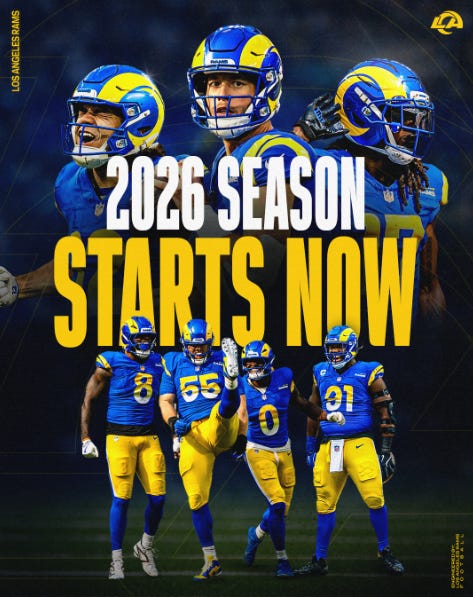
The funniest thing about the NFL in March is how quickly chaos gets mistaken for truth. A rumor catches one gust of wind, gets repeated often enough, and suddenly people start talking about it like it was a front-office master plan all along. I got a notification about it on my phone during a very confusing breakfast. Not only was the rumor confusing, but I was also baffled that this breakfast place thought it was acceptable to cook waffles in a microwave. But anyway, that is exactly what happened with the Los Angeles Rams and the Davante Adams noise over the weekend.
Let’s shut that down right away.
Davante Adams was not “going somewhere.” He was not on some clear runway out of Los Angeles. He was not being lined up in any direct swap for A.J. Brown. And if that rumor had been presented as a certainty from the beginning, it deserved to be challenged from the beginning. The only specific report that the Rams were exploring moving Adams while looking into Brown came from a single league-source report, while separate reporting confirmed Los Angeles had legitimate interest in Brown without broad, independent confirmation of some full-blown, organized Adams exit plan. Sean McVay had already said in February that he “absolutely” expected Adams back and had no reason to believe otherwise, which makes the louder version of the rumor look even shakier now.
And then came the simplest reality check of all: Adams’ $6 million roster bonus hit on March 16, and the Rams let it hit. That does not magically prove there were never exploratory conversations anywhere in the background, because teams check on everything this time of year. But it absolutely does mean the breathless version of the story got ahead of the facts. If the Rams truly had some urgent, committed plan to dump Adams, they did not execute it before that trigger date. Instead, they moved forward with him still on the roster, still tied to Matthew Stafford, and still sitting in the middle of a passing game that was one of the most dangerous in football when healthy.
Let’s also clear something up for the geniuses pushing that rumor. In the 2025 NFL regular season, Davante Adams led the entire league in receiving touchdowns with 14 while playing for the Los Angeles Rams. A player producing at that level was never realistically going anywhere. The idea that the Rams were preparing to move on from the league’s touchdown leader never made sense to begin with.
Even after missing the final three games of the season with a hamstring injury, Adams still finished the year with 60 receptions for 789 yards and those league-leading 14 touchdown catches, proving once again how dangerous he remains in the red zone and in high-leverage situations.
His performance also made history, as he became the first player in NFL history to lead the league in touchdown receptions with three different franchises—the Green Bay Packers, the Las Vegas Raiders, and now the Los Angeles Rams. When you step back and look at the production and the chemistry he developed with Matthew Stafford, it becomes obvious why the Rams had no real reason to move him.
The plan is already in place, and Adams remains a major part of it. That matters, by the way, because once you stop reacting to rumors and actually look at the roster, the Rams’ offseason becomes much easier to read. Everything is much clearer now.
This is the part where everything changes.
A few days ago, it was fair to stare at this team and think cornerback had to be a Day 1 draft priority. That was the glaring hole. That was the spot people circled. That was where I was most angry after the year ended. That was the part of the defense that felt unfinished. Then the Rams went out and changed the entire conversation in a hurry. They traded for Trent McDuffie, gave him a four-year extension worth $124 million, signed Jaylen Watson to a three-year deal, and brought back Kam Curl. In one wave, they turned the secondary from the weak point into a strength. More importantly, they did exactly what Les Snead says he wants to do every year: use free agency and trades to remove desperation from the draft.
That is why this week feels different now that I had to breathe and think about our plan.
This is not a roster screaming for rescue anymore. This is not a roster begging to be patched together. This is a roster that already looks like a force and now gets to draft from a position of comfort instead of panic—or better yet, desperation—or both is where we were at two weeks ago.
Right now, the roster is solid at almost every level, and it’s wild how locking down the cornerback position—what I consider the most difficult position in football to execute successfully—can change the entire outlook of a defense.
When that spot is secured, the entire defense becomes stronger, even beyond the defensive backs themselves. It changes how everything functions. Because of that, I’m not even sure the Rams need to force an edge rusher anymore. That was originally my thinking when the team had two first-round picks before using No. 29 in the trade for Trent McDuffie. But now the equation looks completely different.
Remember too, Byron Young and Jared Verse are nothing to sneeze at. Both are edge rushers for the Rams and are already becoming imposing forces on that defensive front.
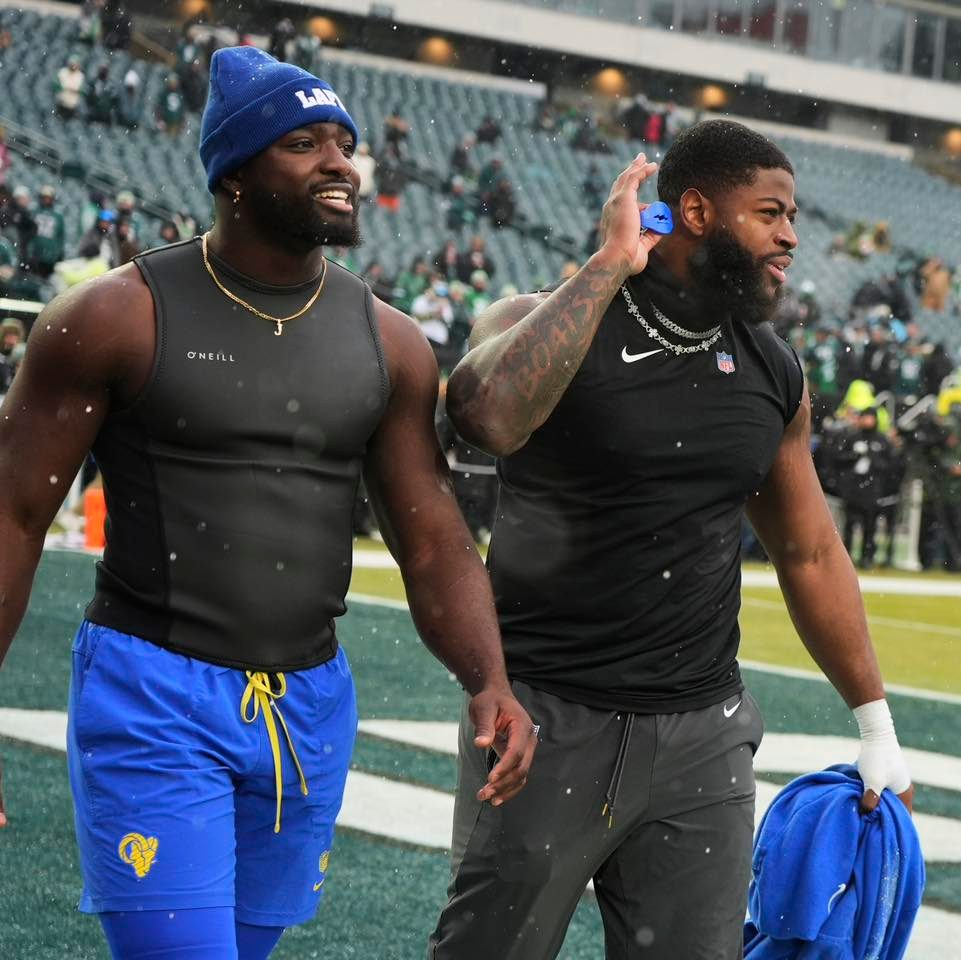
The Rams still hold the No. 13 overall pick, the one they originally acquired from Atlanta, even after sending their own No. 29 pick to Kansas City in the McDuffie trade. So instead of using that premium selection to chase a need at corner, the Rams can aim higher. They can take a genuine difference-maker. They can target somebody who changes games right away. They can draft impact, not survival.
That is why the entire draft board should be viewed through a different lens now. By that, I mean I see it very differently than I did even a few days ago.
The Rams do not need to force a corner. They do not need to force safety. They do not need to reach for another flashy receiver just because there was one wild week of internet noise around A.J. Brown. The offense already got an important bit of stability with Tyler Higbee returning on a two-year deal, and the bigger point remains the same: if Stafford is upright and Adams and Puka Nacua are both on the field, this offense is not lacking headline talent for up to three more years of togetherness. The Rams’ own site acknowledged that, after free agency, mock drafts suddenly had them linked to more offensive weapons at No. 13 because the earlier pressure to fix the secondary was gone. But that is where the Rams now have flexibility instead of obligation.
And that brings us to the real football conversation.
After taking that breath, letting the shock of the cornerback moves wear off, and laying the whole roster out to look at it straight on, the Rams really don’t need much in terms of figuring out what the team still needs—if that makes sense. In other words, everything is much more concise now.
They need the right thing.
There is a difference.
That is why the entire draft board should be viewed through a different lens now. And by that, I mean I’m looking at it very differently than I was even a few days ago. I was honestly trying to push thinking about it off a few more weeks.
If there is an elite edge player sitting there at No. 13 who can arrive as an immediate closer, then that is still a very clean answer. Nobody should ever apologize for adding a pass rusher who can end drives, finish games, and tilt a playoff pocket in the fourth quarter. There is no such thing as too much pressure when January football arrives.
But the more interesting development is this: now that the back end has been fortified, the Rams may not have to force the outside pass-rush conversation the way some people assumed.
Like we mentioned, Jared Verse is already in house. Byron Young is already in house. Remember, those two are nothing to sneeze at. They are legitimate edge rushers and imposing forces already developing on this defensive front. Both are also still growing, and both stand to benefit from tighter coverage behind them. Better corners can buy a defensive front an extra beat, and in the NFL that extra beat is often the difference between a pressure and a sack. We saw that for years when Aaron Donald was collapsing pockets—quarterbacks simply didn’t have time. By the Super Bowl, that defense was swallowing up offenses, walking through the line and stopping plays before they could even develop behind the line of scrimmage.
So if the Rams do stay on defense at No. 13, the most compelling non-edge idea may actually be the one that is finally starting to come into focus: an inside disruptor. A true interior difference-maker who can impact the game on Day One.
That is the shift.
Not because edge suddenly stopped mattering. It always matters. But because the Rams no longer have to shop from desperation, they can think more specifically about how to make a good defense become a scary one.
An interior force next to Kobie Turner could completely change the geometry of the defensive front. It could collapse the pocket faster, muddy the quarterback’s sightlines, and create cleaner one-on-one matchups for the edge players already on the roster. If the right interior defender is there, the Rams should absolutely be open to that. They should not draft for the old hole when the old hole has already been filled.
At the same time, the Rams still need to think about finding Day One game breakers.
That is the real challenge facing Les Snead right now. Finding a “Day One Game Breaker” at No. 13 while simultaneously planning for the post-Matthew Stafford era is the needle he has to thread. If you want a player who can change the game the second he steps onto the field, the board usually splits into two directions.
The first path is the defensive game breaker.
If Arvell Reese is there at 13, he is exactly that type of player. He is one of the most explosive defensive prospects in the 2026 class and has been ranked among the top edge or outside linebacker prospects in the draft by multiple major evaluators. His burst forces quarterbacks to throw earlier than they want to, which directly benefits the secondary. That is exactly how corners like Trent McDuffie and Jaylen Watson end up with interceptions—quarterbacks rush throws because the pressure is real. Reese’s explosiveness and block-destruction ability are the exact traits teams chase when they want a defender who changes the math of a game.
The comparison everyone makes when they talk about a closer is Von Miller, and that is not accidental. If the Rams want that kind of game-tilting presence, Reese is one name, but he is not the only one. David Bailey out of Texas Tech, Rueben Bain Jr. out of Miami, R Mason Thomas out of Oklahoma, and T.J. Parker out of Clemson are all part of the real 2026 edge conversation and all fit the broader point here: if Los Angeles wants a true heat-seeking pass rusher at 13, this class does offer them legitimate options.
But there is also the second path the Rams cannot ignore: planning for life after Matthew Stafford.
Depending on how the next one to three years unfold—and depending on Stafford’s health—the Rams eventually need someone ready to take over. If a quarterback unexpectedly slides, the Rams may need to consider that option.
Ty Simpson from Alabama could fit that type of developmental mold. He has the arm talent and the pocket-passing skill set that make the Stafford comparison understandable, and he is already viewed as one of the better quarterback prospects in this class. Carson Beck is another possibility if the board gets strange, and there are evaluators who also like the broader top of this quarterback group built around names like Fernando Mendoza and Garrett Nussmeier. But the larger point stays the same: if the Rams are thinking long term, the successor conversation is real, even if the timing has to be right.
Let me be clear about one thing: the Rams should not be drafting a quarterback with the No. 13 pick. That pick needs to be reserved for a true Day One game breaker—someone who can impact the roster immediately, whether that’s an elite edge rusher or a dominant defensive lineman. The goal at that spot is to strengthen a team that already looks like a contender, not to reach for a long-term project when there are still players available who can make an immediate difference on Sundays.
That doesn’t mean the quarterback conversation disappears entirely. It just needs to happen at the right point in the draft. Ideally, the Rams would look for a developmental quarterback later—somewhere around the fourth round if the board breaks the right way. That gives the team a young player who can begin learning Sean McVay’s system without the pressure of having to play immediately, especially with Matthew Stafford still firmly in control of the offense. The same logic applies to the kicking situation. The Rams should absolutely address that as well, but it belongs in the middle-to-late rounds—somewhere in the fourth or sixth round—where they can bring in competition without sacrificing premium draft capital.
The key to this entire strategy is that the Rams still held onto their second-round pick (No. 61), and that is huge. Even after making the aggressive move to acquire Trent McDuffie, keeping that pick gives Les Snead flexibility in the sweet spot of the draft. That is the range where the Rams could grab a high-end offensive tackle to protect Stafford, or even take a calculated swing at a future quarterback if someone like Ty Simpson or Carson Beck happens to slide further than expected.
When you step back and look at the draft capital the Rams still hold, the plan becomes pretty clear. The first round is where they should hunt for the big impact player. The second round becomes the insurance policy—either reinforcing the offensive line or taking a developmental quarterback if the value lines up. The third round adds depth, likely somewhere in the defensive backfield or linebacker group, and the late rounds are where the Rams can finally address special teams and stabilize the kicking situation.
So the draft “war chest” now looks something like this:
Round 1 (No. 13): The game breaker—edge rusher or defensive line disruptor.
Round 2 (No. 61): The insurance—offensive tackle or developmental quarterback.
Round 3 (No. 93): Depth—possibly safety or linebacker.
Late rounds (6–7): Special teams help, including a kicker.
Yes, the Rams did give up their fifth-round pick in the trade package with Kansas City, but holding onto that second-round selection keeps the entire strategy intact. With that pick still in hand, Les Snead has enough ammunition to be dangerous—and more importantly, enough flexibility to keep building a roster that already looks much closer to complete than it did just a week ago.
There is even a wild-card offensive scenario if the Rams decide to lean fully into overwhelming firepower.
Denzel Boston from Washington is a 6-foot-4 receiver who would create absolute nightmares in the red zone, and Carnell Tate from Ohio State is another one of the top wide receivers in this class. Imagine a red-zone offense featuring Davante Adams, Puka Nacua, and another big-bodied target with that kind of size—not to mention Tyler Higbee at tight end, who is huge as well. Stafford wouldn’t have to thread needles anymore. He could simply throw the ball where only his giant target could reach it. That is the kind of move that could extend Stafford’s career, because it reduces the need for perfect throws and tight-window passes.
Of course, there is also a completely different type of “game breaker” the Rams desperately need to address: special teams.
Last season, special teams were awful across the board. That cannot happen again if this team expects to compete deep into the postseason. A real special-teams game changer might not even be a kicker—it could be a return specialist. One that does not fumble would be ideal.
A late-round speed threat like Zachariah Branch could flip field position instantly and give the Rams something they have lacked for years: explosive return yardage that sets the offense up with short fields.
And yes, offensive line depth still matters. It always matters. Every year, every team has to address its offensive line situation. There was a time when the Rams rarely had to worry about it because they had players who stayed with the team for decades as offensive linemen. There was even a stretch when the team had essentially the same offensive line for about six years in a row. Maybe longer.
If the top defensive playmakers are gone, the Rams could pivot to offensive tackle. The current 2026 tackle class is led by names like Francis Mauigoa, Spencer Fano, Monroe Freeling, Caleb Lomu, and Kadyn Proctor. Those are the types of players who could anchor the offensive line for years while protecting Stafford’s blind side.
Right now on defense, the Rams are leaning heavily on Byron Young and Jared Verse as their primary edge rushers. They have both shown promise, but neither has yet demanded consistent double teams. Adding a blue-chip edge player would finally give the defense that fear factor coming off the outside.
And if the Rams—meaning me—truly want that Von Miller-type impact player, the guy who can take over a game in the fourth quarter, then Arvell Reese, David Bailey, or R Mason Thomas are the names that now belong in this conversation, not the ones from last year’s class. That is the correction. That is the real 2026 conversation. And that is the kind of player who could push this defense over the hump.
But even without that addition, the reality is this: the defense might already be in a better position than people realize.
With Trent McDuffie leading the secondary, coverage should hold longer. That gives players like Jared Verse and Byron Young an extra half second to get to the quarterback. In the NFL, that half second can be everything.
Meanwhile, Kobie Turner is still ascending after recording nine sacks as a rookie.
So yes, the defense is already good.
But if the Rams hit on the right player at No. 13—whether that’s an elite edge closer, a dominant interior disruptor like Peter Woods or Caleb Banks, or even a long-term quarterback successor—the defense and the roster as a whole could become something much more dangerous. Woods and Banks, in particular, are among the more highly regarded interior defensive linemen in the actual 2026 class, and both fit the broader idea of adding force next to Kobie Turner instead of chasing an old need that has already been addressed.
And that is the real point here. The Rams no longer need to draft from panic. They can draft for impact.
That is why the post-trade version of this team is easier to understand than the pre-trade version.
The cornerback trade did not just improve the secondary. It simplified the Rams’ identity for me at least. It made this part of my life and job a lot easier and much more concise.
Now you can see the remaining checklist for what it really is.
To be clear, offensive line still matters because offensive line always matters. Stafford is the center of the whole operation, and the Rams have made it clear their entire 2026 approach is about maximizing the window with him. His $40 million salary for 2026 became fully guaranteed on March 16, which tells you everything you need to know about the organization’s commitment to the current timeline. This is not a patient, long-horizon reset. This is a win-now team. And win-now teams do not get cute about protection. They keep feeding the line, even when the line looks solid. If the Rams use one of their five picks on an offensive lineman, nobody should blink. If they use two, even better.
That said, No. 13 feels too valuable now to spend on a mere insurance policy unless the board falls in a very specific way. That pick should be for a real immediate-impact player. Somebody who can be felt right away. Somebody who adds violence, disruption, or stability at a level this roster cannot currently match. That is why the conversation comes back to the front seven more than anything else. If there is a true Day 1 force available, that is the luxury of what the Rams have created for themselves with the McDuffie-Watson-Curl stretch. They have earned the right to swing for impact.
Special teams, meanwhile, remain the area fans are most justified in distrusting. That needs to be discussed and addressed like yesterday too.
The Rams did make a meaningful move there by signing long snapper Joe Cardona to a two-year deal, and that matters more than casual fans often admit. Good special teams start with execution, and execution starts with reliability. But stabilizing the snap does not solve the broader anxiety. It does not erase the memory of missed extra points—unless the issue somehow traces back to the center from last year—because our kickers missed plenty of field goals and extra points last season. It does not suddenly create full confidence in the kicking game. It simply means one piece of the special-teams mess has been addressed.
That brings us to the kicking situation, which still needs to be addressed, even if the Rams have already taken a step toward stabilizing it.
Joshua Karty is no longer part of the picture after being waived, which means the Rams have effectively turned the page and are now looking toward Harrison Mevis as the current option in the building. The team tendered Mevis as an exclusive rights free agent on March 2, securing him for the upcoming season after he was initially added to the practice squad in November of 2025.
Mevis, known as “The Thiccer Kicker,” already has a bit of a reputation for that massive leg strength, and honestly he reminds me a little of Tom Dempsey. That comparison is only half joking, but it fits when you watch the way he can drive the ball. He has the type of leg that can hit from deep range without much hesitation. After a strong 2025 season in the UFL with the Birmingham Stallions, where he went 21-for-23 on field goals, the Rams clearly saw enough to bring him into the organization and keep him under contract.
But leg strength has never really been the Rams’ problem.
The issue has been reliability.
Last season the kicking situation became a headache because the misses weren’t coming from impossible distances—they were coming on the kicks that should be automatic. Extra points. Short field goals. Those are the ones that drive myself and Coach McVay crazy, and they should. Missed PATs change the entire flow of a game. Suddenly coaches are chasing points, going for two earlier than they want to, and making strategic decisions they shouldn’t have to make.
That’s why kicker still belongs somewhere on the draft board, even if it’s not anywhere near the top.
The Rams can absolutely live with a late-round solution here. A sixth- or seventh-round kicker would make perfect sense, especially if the front office wants real competition in training camp, which we need to have this year. Bring in another leg, let him compete with Mevis, and make it very simple: the guy who makes the kicks stays.
Special teams are one of those areas that people love to ignore until they start costing games. And last season proved how quickly those problems can snowball. Field-position swings, missed points, momentum shifts—it all adds up.
So while the Rams don’t need to panic about kicker the way they did about the secondary earlier this offseason, they still need to finish the job.
If Mevis becomes the answer, great. If a late-round rookie wins the job, even better. Either way, the Rams cannot go into a season with Super Bowl expectations and pretend that special teams are an afterthought.
Because when everything else on the roster is starting to look this complete, the smallest details suddenly become the ones that decide championships.
And last, there is the longer-range issue sitting quietly behind all of this.
Eventually, whether the window is one year, two years, or three, the Rams are going to have to think about life after Stafford. That remains true no matter how aggressive the current offseason has been. But that does not mean the successor conversation has to hijack this particular moment. The roster now is strong enough that the primary responsibility of pick No. 13 should be helping the 2026 Rams, not just the 2028 Rams. The quarterback succession plan can develop on its own timeline if the board does not present something extraordinary. Right now, the main story is simpler: Los Angeles has done enough early work to make the first round about adding force, not filling fear.
Which is exactly where we want to be.
Today at the Sunset Entertainment & Media Companies
Crime 101 Now Streaming on Sunset: A High-Stakes Crime Thriller Where Precision, Power, and Pursuit Collide
Live From The Vault on Live Jam Tonight features Robin Trower – One Moment In Time – Live In The USA
Sustainable Action Now: New Mass Incarceration Trends, Sandro the Tiger, Wild Birds, Global Oil, Stop Norway Whaling, Ultimate Açaí Smoothie, Gordo and Florencia, More!
Bon Jovi Movie, CHAMPS Trade Show, The Messi Experience, The Bruce Springsteen Center for American Music, Devils Face Calgary Flames, Craft Beverage Month, Filmology Labs, More!
State Budget Address is Tonight, Logan Paul, Jacquie Lee, Boba Lions, Devils Prospect Daniil Orlov, Release Reentry Center Program, Asbury Park Music Awards
The Vending Lot Pickleball Collection Is Turning Everyday Play Into Pop-Culture Performance
March Madness Ignites College Basketball—and the Pro Merch NCAA Collection Delivers the Ultimate Fan Gear for the Tournament’s Biggest Moments
Nature’s Sunset Creatine Monohydrate: The Performance-Driven Supplement Elevating Strength, Recovery, and Modern Fitness
Corporations Are People, My Friend